You don’t need to be an artist. You don’t need expensive tools. You don’t even need to be “crafty.” All you need is a hook, some yarn, and five minutes today.
That’s it.
Crocheting isn’t some mysterious skill reserved for grandmas in rocking chairs or Pinterest-perfect influencers with perfectly symmetrical blankets. It’s one of the most accessible, calming, and surprisingly rewarding hobbies you can pick up right now — even if you’ve never held a hook before.
And if you’ve ever stared at a cozy crochet blanket at a farmer’s market, or watched a TikTok video of someone turning a single loop into a fluffy amigurumi bunny, and thought, “I wish I could do that…” — this guide is for you.
In the next 2,000 words, we’ll break down exactly how to start crocheting the easy way. No confusing terminology. No overwhelming patterns. Just clear, step-by-step guidance that turns “I can’t” into “I did!” We’ll cover what tools you actually need (hint: it’s less than $15), the first three stitches you must learn (and why they’re all you’ll ever need), how to fix your very first mistakes without starting over, and even how crocheting can reduce stress, boost creativity, and give you handmade gifts that mean more than anything store-bought.
By the end, you won’t just know how to crochet — you’ll want to keep going.
Let’s begin.
Why Crocheting Is the Perfect Hobby for Beginners (Yes, Even If You’re “Not Crafty”)
Let’s be honest: most of us feel intimidated by crafts. We see Instagram posts of intricate lace doilies or hyper-detailed amigurumi animals and think, “That took months. I could never.”
But here’s the truth no one tells you: every expert crocheter started exactly where you are right now.
Crocheting is one of the few hobbies where progress is immediately visible. Unlike painting, where you might spend hours and end up with a muddy blob, or knitting, where a dropped stitch can unravel everything, crocheting gives you instant feedback. One loop. One pull. One stitch. And suddenly — you’ve made something.
It’s also incredibly forgiving. If you mess up? Just pull it out. Literally. Yarn is reusable. No wasted money. No wasted effort. Just a little tugging, and you’re back to square one — with more experience.
And the benefits? They’re real.
A 2020 study from the University of Wollongong found that 74% of people who regularly engaged in crafts like crocheting reported reduced stress and improved mood. Why? Because it activates what psychologists call “flow state” — that sweet spot where your mind is fully immersed, time slips away, and anxiety fades.
Plus, it’s portable. You can crochet while watching TV, waiting in line, riding the bus, or even during Zoom calls (no one has to know). It’s a quiet, tactile way to reclaim your mental space in a world that’s always buzzing.
You’re not learning to make blankets. You’re learning to slow down. To create. To be present.
And that? That’s worth more than any pattern.
The Only 3 Tools You Actually Need (And Where to Get Them for Under $15)
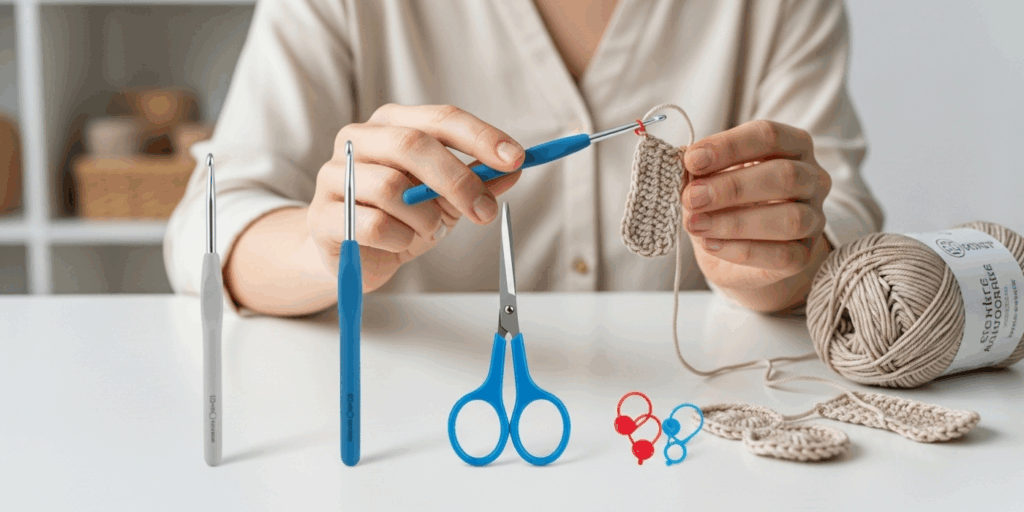
Let’s cut through the noise.
You don’t need a $50 yarn basket. You don’t need 12 different hook sizes. You don’t need to buy 17 colors of “artisanal organic cotton.”
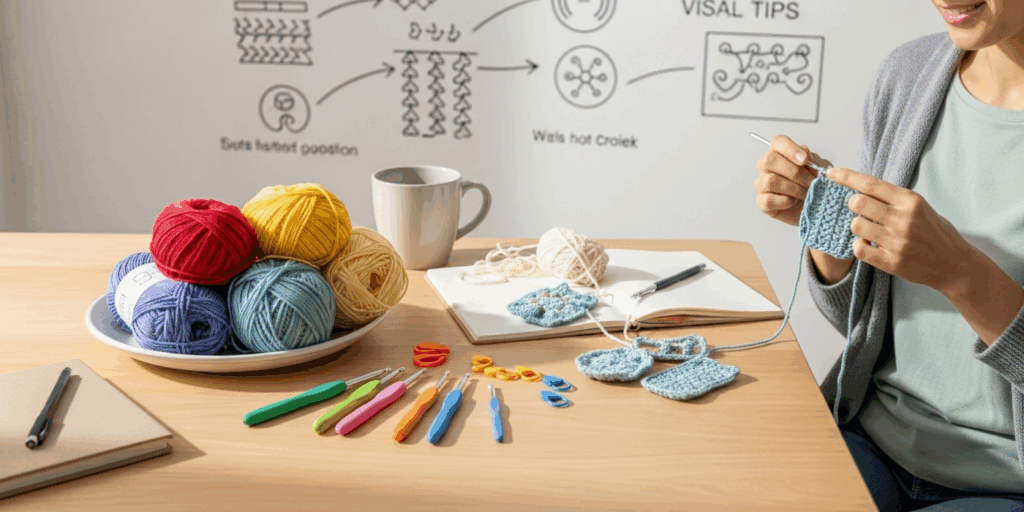
Here’s your starter kit — the absolute minimum to get started:
- A 5mm (H-8) Crochet Hook
This is the Goldilocks size for beginners. Not too small, not too big. It’s easy to hold, works well with medium-weight yarn, and lets you see your stitches clearly. Look for one with a soft, ergonomic grip — it’ll save your fingers later. - One Ball of Medium-Weight Yarn (Worsted Weight, Size 4)
Avoid novelty yarns (bumpy, sparkly, or super thin). Stick with a solid color in acrylic or cotton. Red Heart Super Saver or Lion Brand Basic Stitch are affordable, durable, and come in tons of colors. One ball (about 190 yards) is enough to practice your first project. - A Pair of Scissors (or Just Use Your Fingers)
Seriously. You can cut yarn with your nails if you have to. But if you want to be fancy, a small pair of embroidery scissors costs $3 at any craft store or Amazon.
That’s it. $10–$15 total. No subscription. No membership. No extra gear.
Pro tip: Buy your hook and yarn together. Many stores (like Michaels, Joann, or even Walmart) sell beginner kits that include both for under $12. Look for “Crochet Starter Kit” or “Learn to Crochet Bundle.”
And here’s the secret: your first project doesn’t need to be perfect. It just needs to exist.
Start with a simple rectangle. Just chains and single crochets. It’ll look like a slightly lopsided placemat. And that’s okay. That’s your victory.
The First 3 Stitches You Must Learn (No Jargon, I Promise)
Okay, let’s get hands-on.
There are hundreds of crochet stitches. But you only need three to make 90% of beginner projects: the chain, the single crochet, and the double crochet.
That’s it.
Let’s break them down — no confusing terms like “yarn over” or “insert hook under two loops.” Just plain English.
1. The Chain Stitch (ch) — Your Foundation
Think of this as drawing a line with yarn.
- Hold the hook like a pencil.
- Make a slip knot (just loop the yarn, pull a tail through, and tighten gently on the hook).
- Yarn over (wrap the yarn around the hook from back to front).
- Pull that yarn through the loop on your hook.
- Repeat.
You’re making a chain. 10 stitches? That’s a start. 50? Even better. This is your base row. Don’t worry if it’s uneven. It will be. That’s normal.
2. The Single Crochet (sc) — Your First Real Stitch
This is the building block.
- Insert your hook into the second chain from the hook.
- Yarn over.
- Pull up a loop (now you have two loops on the hook).
- Yarn over again.
- Pull through both loops.
One single crochet done. Repeat across your chain. You’ll feel a satisfying little click with each stitch. That’s your progress.
3. The Double Crochet (dc) — Your First “Taller” Stitch
This one’s faster and creates a looser fabric.
- Yarn over.
- Insert hook into stitch.
- Yarn over. Pull up a loop (now you have 3 loops on hook).
- Yarn over. Pull through 2 loops.
- Yarn over again. Pull through the last two loops.
Boom. You’ve done it.
Practice each stitch for 10 minutes. Make a 6-inch square. Do it tomorrow. Do it after dinner. Don’t aim for perfection — aim for consistency.
And here’s a game-changer: watch a 3-minute YouTube video of someone doing these stitches. Visuals stick better than instructions. Search: “Crochet for beginners chain single double crochet.”
You’ll be amazed how quickly your hands remember what your brain just learned.
How to Fix Mistakes (Without Starting Over — Yes, Really!)
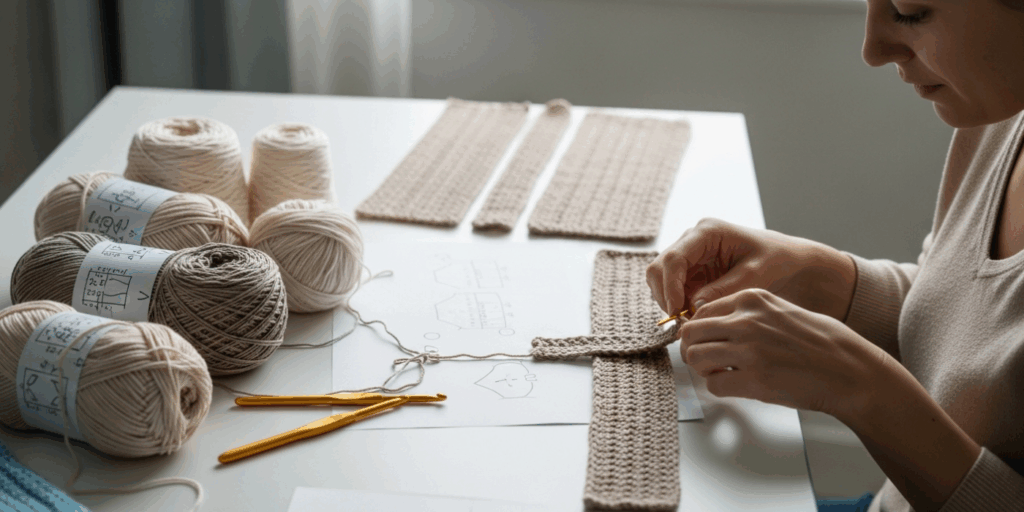
Let’s talk about the #1 fear: “I messed up. Do I have to rip it all out?”
Spoiler: No.
Mistakes are part of the process. In fact, they’re your best teacher.
Here’s what to do when things go sideways:
- Too tight? Your yarn is pulling like a rubber band. Solution: Breathe. Relax your grip. Think of holding the hook like you’re holding a baby bird — firm enough to control, gentle enough to not hurt it.
- Gaps between stitches? You’re not inserting the hook deep enough. Try pushing the hook all the way through the stitch before pulling up the loop.
- Accidentally added a stitch? You might’ve crocheted into the same spot twice. Count your stitches every row. If you have 12, you should still have 12. If you have 13? Just skip one next row — you’ll even out.
- Lost your place? Use a stitch marker (a safety pin or a scrap of contrasting yarn) to mark the first stitch of each row. It’s a tiny thing, but it saves hours.
And if you really mess up? Pull the yarn. Gently. One loop at a time. It unravels like a zipper. You’ll be back to your starting chain in under a minute. No shame. No loss. Just practice.
I once crocheted a scarf for my sister. I messed up the color change so badly, it looked like a rainbow had a seizure. I didn’t throw it away. I turned it into a pot holder. She still uses it. And laughs every time.
Your first project won’t be Instagram-worthy. But it’ll be yours. And that’s what matters.
Turn Your First Square Into Something Real (And Feel Proud)
So you’ve made a 6-inch square. What now?
Here’s where most beginners quit — because they don’t know what to do with it.
Let me give you three simple, satisfying ideas:
1. Make a Coaster
Crochet four squares. Sew them together with a yarn needle (just poke the yarn through the edges). Done. You’ve made functional art. Use it for your coffee mug. Feel that tiny pride.
2. Turn It Into a Blanket (Yes, Really)
Crochet 10 squares. Sew them into a 2×5 grid. Add a border with single crochet around the whole thing. Boom — a baby blanket. Or a lap blanket. Or a gift for your mom. It doesn’t have to be big. It just has to be finished.
3. Make a Phone Holder
Crochet a rectangle (about 4” x 6”), then sew the sides together to form a pouch. Add a loop on the back. Slide your phone in. You’ve made a cozy, handmade phone case.
These aren’t “projects.” They’re proof.
Proof that you can follow a simple process.
Proof that your hands can create something beautiful.
Proof that you didn’t give up.
And that confidence? It spills over into everything else.
The Hidden Superpower: How Crocheting Calms Your Mind (Science-Backed)
You might think crocheting is just a hobby. But it’s actually a form of active meditation.
When you’re focused on counting stitches, feeling the yarn, repeating the same motion over and over — your brain shifts out of “stress mode” and into “calm mode.”
Studies show that repetitive, rhythmic activities like crocheting lower cortisol levels (the stress hormone) and increase serotonin (the happiness chemical). It’s why so many therapists recommend it for anxiety, PTSD, and even ADHD.
I know a woman named Linda who started crocheting after her divorce. She said, “I felt like my mind was a browser with 50 tabs open. Crocheting closed them. One by one.”
She didn’t set out to make blankets. She set out to find peace.
And she did.
You don’t need to heal from trauma to benefit from this. Even if you’re just tired from work, overwhelmed by emails, or scrolling mindlessly before bed — pick up your hook for 10 minutes. Let your hands do the thinking. Let your mind rest.
It’s not magic. It’s neuroscience.
And it’s free.
Your First 30-Day Crochet Challenge (No Pressure, Just Progress)
Here’s your invitation.
Commit to 10 minutes a day for 30 days.
That’s it.
Day 1–5: Practice chains. Just 20 each day.
Day 6–10: Add single crochet. Make a 5-stitch row.
Day 11–15: Add double crochet. Make a 10-stitch row.
Day 16–20: Combine them. Make a 6×6 square.
Day 21–25: Make a second square. Sew them together.
Day 26–30: Add a border. Take a photo. Send it to a friend. Say: “I made this.”
You don’t need to post it online. You don’t need to show anyone. Just do it.
By day 30, you won’t be an expert. But you’ll be someone who didn’t quit. And that’s the difference between dreaming and doing.
Celebrate every stitch. Every mistake. Every completed square.
You’re not just learning to crochet.
You’re learning to trust yourself.
Final Thought: You Don’t Need to Be Good. You Just Need to Begin.
I used to think creativity was something you were born with — like singing or drawing.
Then I learned to crochet.
And I realized: creativity isn’t talent. It’s practice.
It’s showing up when you’re tired.
It’s trying again when you mess up.
It’s choosing to make something with your hands instead of scrolling through someone else’s perfect life.
Crocheting doesn’t care if you’re young or old. Rich or broke. Confident or unsure.
It only asks for your time.
And in return? It gives you patience. Presence. Pride.
So grab that hook. Find a ball of yarn. Make one chain.
Just one.
Then come back tomorrow.
And make another.
Because the most beautiful things in life aren’t made in a day.
They’re made stitch by stitch.
Your Turn:
What’s the first thing you’re going to make with your crochet hook? A coaster? A phone holder? A tiny dinosaur?
Drop a comment below — I read every one. And if this guide helped you take your first step, share it with someone who needs a little quiet joy in their life.
You’ve got this.
One loop at a time. 💛
Luiza Santos is a passionate crochet and knitting enthusiast who finds joy in transforming simple yarn into meaningful, handmade creations. With a deep love for texture, color, and craftsmanship, she believes every stitch carries a story. Luiza brings warmth, creativity, and years of hands-on experience to everything she makes, inspiring others to discover the beauty of fiber arts.