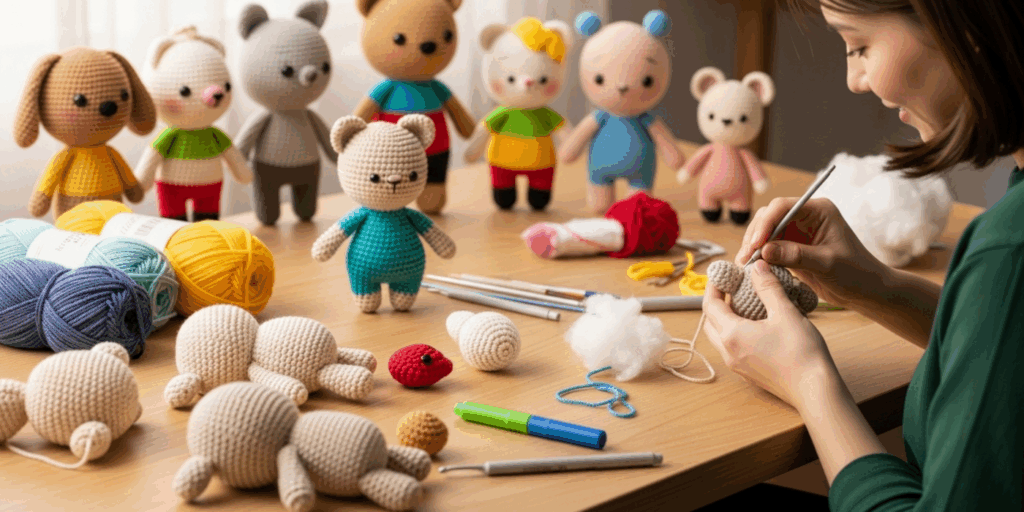
Imagine holding a tiny, hand-stitched creature in your palm—its round cheeks dimpling just slightly, its limbs perfectly plump but not lumpy, its eyes sparkling with personality. It doesn’t look like it was crocheted. It looks alive.
That’s the magic of amigurumi sculpting.
Most beginners think amigurumi is just about following a pattern and stuffing it full until it’s firm. But the real art? It’s in the shape. The subtle curves. The way a nose tapers just so. The gentle swell of a belly that makes your heart melt. When you master sculpting and stuffing, your creations stop being cute crafts—and become cherished keepsakes.
In this guide, we’re diving deep into the secrets professionals use to turn yarn into living, breathing characters. No more lopsided heads, no more bulging limbs, no more “why does my bunny look like a deflated balloon?” We’ll walk through the why behind each stitch, the how of strategic stuffing, and the little tricks that separate good amigurumi from unforgettable amigurumi. Whether you’re a beginner who’s tired of uneven shapes or a seasoned crocheter ready to level up, these techniques will transform your work—and maybe even your relationship with your yarn.
Let’s begin.
Why Shape Matters More Than You Think
You’ve probably heard the phrase, “It’s all in the stuffing.” But here’s the truth: stuffing doesn’t create shape—it reveals it.
Think of your amigurumi like a sculpture made of yarn. The stitches are the clay. The stuffing is the armature holding it in place. If your increases and decreases aren’t placed with intention, no amount of polyester fiberfill will fix a crooked head or a squashed tail.
Take the classic amigurumi head, for example. Most patterns say: “Increase in every stitch for 6 rounds, then decrease.” But if you just follow that blindly, you end up with a sphere—like a tiny, lumpy ball. A real head? It’s slightly oval. The forehead is a bit higher. The chin tucks under. The cheeks round out just below the eyes.
That’s not magic. That’s strategic shaping.
Professionals use offset increases and decreases—spacing them out so the curve flows naturally. Instead of increasing every stitch in round 5, you might increase every other stitch, then every third, creating a gentle slope. You might add an extra increase at the front to push the muzzle forward. You might even use invisible decreases to keep the surface smooth.
And here’s the kicker: your stuffing technique must match your shaping. If you’ve sculpted a soft, rounded cheek but stuffed it too tightly in the back, the whole face will warp.
This isn’t just theory. I once made a panda that looked like it had a double chin… until I reworked the increases and stuffed it in layers. Suddenly, it had character. It looked thoughtful.
The lesson? Shape comes first. Stuffing supports it.
Start thinking like a sculptor, not a packer.
The Art of Layered Stuffing: Less Is More (Seriously)
Let’s talk about stuffing.
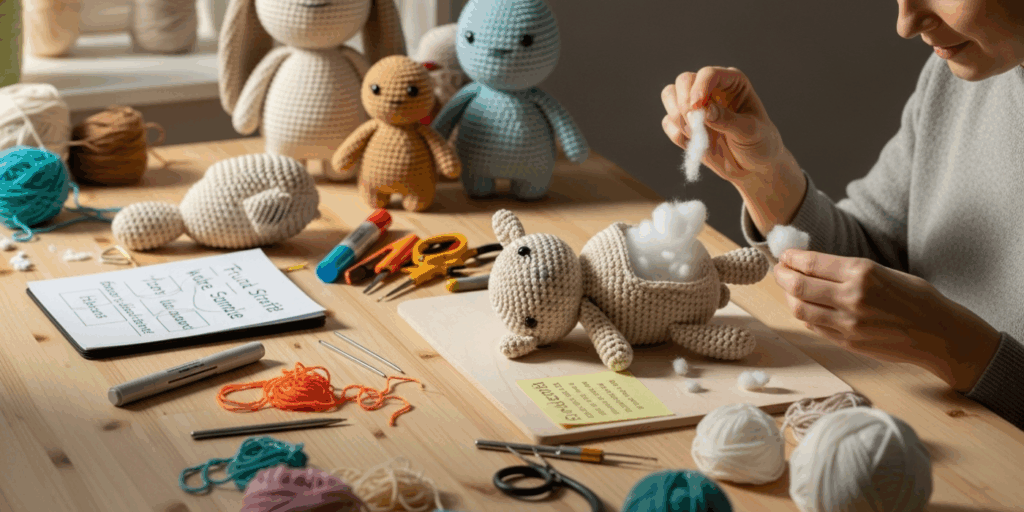
Most of us grab a handful of fiberfill, shove it in, and hope for the best. But here’s what pros know: stuffing isn’t about filling—it’s about building.
Imagine building a sandcastle. You don’t dump the whole bucket at once. You layer it. Pack it. Shape each layer as you go.
The same goes for amigurumi.
Step 1: Start with a base.
Before you even begin stuffing, place a small, firm core in the center of your piece—like a tiny marble of tightly rolled fiberfill. This gives your character structure. A head without a core tends to collapse inward when sewn shut.
Step 2: Stuff in layers.
Don’t stuff the whole limb at once. Add a little, then gently mold it with your fingers. Push the stuffing toward the tip of an arm or leg to create a natural taper. Then add more, shaping as you go.
Step 3: Use different densities.
Here’s the pro trick: use firmer stuffing in areas that need definition (like the head, feet, or nose) and softer stuffing where you want gentle curves (like the belly or cheeks).
I keep two types of fiberfill on hand: one labeled “Firm” (for structure) and one “Fluffy” (for softness). For a kitten’s ears? Fluffy. For its paws? Firm. For its tummy? Just a whisper of softness.
Step 4: Don’t overstuff.
This is where most people fail. Overstuffing doesn’t make your amigurumi “cute and squishy”—it makes it distorted. Bulging eyes. Stretched seams. A tail that looks like a hot dog.
Your goal? Firm, but flexible. When you press gently, it should spring back—not stay dented.
Try this test: After stuffing, pinch the surface. If you can’t feel the yarn stitches beneath your fingers, you’ve overdone it. You want to feel the texture—you want to see the shape, not just the stuffing.
And here’s a bonus: stuff before you close the last opening. That way, you can adjust, reshape, and redistribute as needed. Once it’s sewn shut, it’s too late.
Shaping Secrets: Where to Increase, Where to Decrease
Now let’s get into the nitty-gritty of shaping.
Your pattern might say: “Round 7: Inc in every other stitch.” But where you place those increases makes all the difference.
Let’s break it down with three common problem areas:
1. The Head: Avoid the “Balloon Head”
A round head looks childish. A realistic head has a slight oval shape. To achieve this:
- Place your increases slightly behind the center front (toward the back of the head).
- Keep your decreases centered on the sides, not the front.
- Add an extra decrease at the chin line to create a subtle “tuck.”
Pro tip: Use a stitch marker to mark the front center. Then, place your next increase 2 stitches to the left and right of it. This gently elongates the head vertically.
2. The Limbs: No More Sausage Arms
Limb shaping is all about tapering.
- Start with a snug base near the body.
- In the middle rounds, increase slowly—every 3rd or 4th stitch.
- In the last 2–3 rounds before closing, decrease every stitch to create a soft point.
For paws or feet, stuff the tip firmly and the base lightly. This creates a natural “bend” when you pose the limb.
3. The Ears: Make Them Stand (or Flop) Naturally
Ears are tricky. Too stiff? They look like antennae. Too floppy? They look dead.
Solution:
- Stuff the base of the ear firmly, but leave the tip barely filled.
- Use a smaller hook for the ear edges to create a tighter, more defined curve.
- For floppy ears (like a bunny), sew them on slightly angled backward. For upright ears (like a cat), sew them straight up.
I once made a fox with ears that kept flopping forward. I thought it was cute—until I saw how unnatural it looked next to real fox photos. I re-sewed them at a 15-degree angle, and suddenly, my fox looked like it was listening… to the wind.
Your stitches are your brushstrokes. Your stuffing, your palette.
The Magic of “Stuffing in Stages” (And Why It Changes Everything)
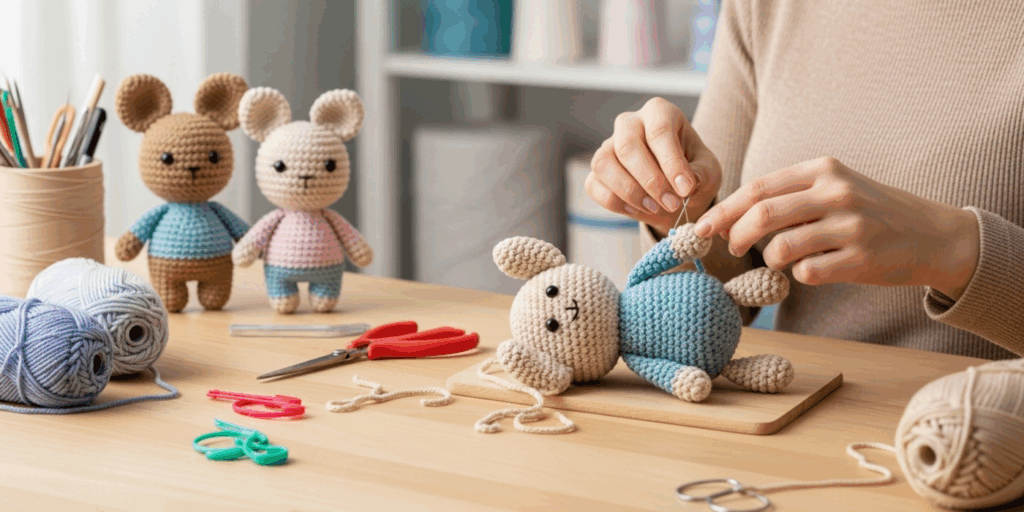
Here’s a secret most tutorials never tell you: you should stuff your amigurumi in at least three stages.
Stage 1: The Core
As mentioned earlier, this is your foundation. A small, dense ball of stuffing placed in the center of each major part (head, body, limbs). It prevents collapse.
Stage 2: The Structure
After you’ve crocheted about halfway through the piece, pause. Insert a little more stuffing—just enough to define the general shape. Don’t close it yet. Use your fingers to nudge the stuffing into the contours you want. Want a rounded belly? Push the stuffing forward. Want a slim waist? Pull it inward.
Stage 3: The Finishing Touch
This is the final stuffing—light, fluffy, and strategic. You’re not adding volume. You’re adding life.
- Gently press the stuffing into the curves.
- Use a chopstick or crochet hook to push fiberfill into tight corners (like between toes or under the chin).
- Leave the last 10% of stuffing for after you’ve sewn the parts together. Why? Because now you can see where it’s really needed. Maybe the neck looks too thin? Add a whisper of fluff there. Maybe the tail looks flat? A tiny bit here fixes it.
This method might feel slow. But here’s the payoff: your amigurumi will look like it was carved, not stuffed.
I once taught a workshop where a student made a duck. Her first version looked like a lumpy pillow. After learning to stuff in stages, her second duck had a beak that curved, a body that swelled gently, and wings that looked like they could flap. She cried. Not because it was hard—but because she finally understood: this was art.
Common Mistakes (And How to Fix Them Before They Ruin Your Creations)
Let’s be real: we’ve all been there.
You finish your project. You’re proud. You take a photo. Then you zoom in… and oh no.
Here are the 5 most common mistakes—and how to avoid them:
- Lumpy Head?
→ Cause: Stuffing too early or unevenly.
→ Fix: Use the 3-stage method. Mold with your fingers after each layer. - Eyes Too Close Together?
→ Cause: Not marking placement before sewing.
→ Fix: Use safety eyes with a ruler. Or, thread a piece of yarn through the head, pull it taut, and measure the distance. Two eyes should fit comfortably between the “nose” and the “forehead.” - Limbs Look Like Tubes?
→ Cause: No tapering.
→ Fix: Decrease in the last 2 rounds. Stuff the tip firmer than the base. - Seams Popping?
→ Cause: Overstuffing + weak stitching.
→ Fix: Use a smaller hook for sewing. Go over seams twice. And never stuff so hard that the yarn stretches. - It Looks… Dead?
→ Cause: No personality.
→ Fix: Add micro-shaping. Slightly flatten the nose. Tilt the head 5 degrees. Give the ears a tiny curl. These small details scream “lived-in,” not “mass-produced.”
Remember: perfection isn’t the goal. Personality is.
A slightly crooked smile? That’s charm. A lopsided ear? That’s character.
But lumpy, uneven stuffing? That’s just… sad.
Your Turn: Sculpt With Confidence
You don’t need fancy tools. You don’t need expensive yarn.
You just need to see your amigurumi as more than a pattern.
It’s a tiny world you’re building—one stitch, one puff of fiberfill, one intentional curve at a time.
The next time you pick up your hook, ask yourself: What story does this creature tell?
Is it a sleepy koala curled in a ball? Then its belly should be soft, its limbs tucked close.
Is it a curious fox peeking around a corner? Then its head should tilt slightly, its ears perked, its nose nudged forward.
Your hands are the sculptor’s chisel. Your stuffing, the clay.
And you? You’re the artist.
I still remember the first amigurumi I made that made someone gasp. It was a tiny owl with mismatched eyes—one slightly bigger than the other. I didn’t plan it. But when I looked at it, I thought: It’s looking at me… with wonder.
That’s the magic.
So go ahead. Try the 3-stage stuffing. Mold that head. Taper those limbs. Leave a little space for imperfection.
Because the world doesn’t need another perfect amigurumi.
It needs yours.
Final Thought: What Will You Create Next?
Now that you know the secrets of sculpting and stuffing like a pro… what will you make?
Will it be a dragon with wings that seem to catch the wind?
A baby fox curled in a leaf, eyes half-closed?
A tiny astronaut floating in a jar of stars?
I’d love to hear about it.
👉 Leave a comment below—share your next project, your biggest “aha!” moment, or even a photo of your latest creation. Let’s build a community of makers who don’t just crochet… we breathe life into yarn.
And if this guide helped you see amigurumi in a new light? Share it with a friend who’s still stuffing like a vacuum cleaner.
Because the best art isn’t made in silence.
It’s made—and shared—with joy.
Happy sculpting. 🧶✨

Luiza Santos is a passionate crochet and knitting enthusiast who finds joy in transforming simple yarn into meaningful, handmade creations. With a deep love for texture, color, and craftsmanship, she believes every stitch carries a story. Luiza brings warmth, creativity, and years of hands-on experience to everything she makes, inspiring others to discover the beauty of fiber arts.