Imagine running your fingers over a blanket that feels like a soft, sculpted landscape—bumps like tiny hills, ridges that catch the light, and deep valleys that seem to whisper warmth. This isn’t magic. It’s crochet.
If you’ve ever felt like your crochet projects are starting to look the same—same stitches, same textures, same predictable patterns—you’re not alone. Many crocheters hit a creative plateau. But here’s the beautiful truth: the world of crochet is far deeper than the classic single and double crochet stitches you learned first. Beyond the basics lie a treasure trove of advanced stitches that transform flat fabric into tactile art. These aren’t just fancy tricks—they’re tools that let you create pieces with depth, dimension, and personality that turn heads and spark conversations.
In this guide, we’ll explore five advanced crochet stitches that unlock rich, unique textures—each one with its own personality, purpose, and practical magic. Whether you’re crafting cozy blankets, statement garments, or one-of-a-kind home décor, these stitches will elevate your work from “nice” to “wow.” We’ll break down how to make them, when to use them, and why they matter—not just for aesthetics, but for the emotional connection you’ll feel when you create something truly original.
By the end, you won’t just know how to work these stitches—you’ll understand how to feel them. And that’s where the real art begins.
The Popcorn Stitch: Where Tiny Bubbles Become Big Impact
Let’s start with a stitch that’s as fun to make as it is to touch: the popcorn stitch.
Picture this: you’re working along a row, and suddenly, you gather five double crochets into one space, pull them tight, and—pop!—a little three-dimensional bubble rises from your fabric. It’s like crochet’s version of a bubble wrap surprise.
The popcorn stitch isn’t just decorative; it’s textural storytelling. Each puff creates a tactile point of interest, catching light and shadow in a way flat stitches never can. Think of it as the embroidery of crochet—small, intentional, and deeply satisfying.
Why it matters: In a world of mass-produced goods, handmade texture is a quiet rebellion. A blanket made with popcorn stitches doesn’t just keep you warm—it invites touch. It tells a story of patience, care, and craftsmanship.
How to do it (simple version):
- Work 5 double crochets into the same stitch.
- Drop the loop from your hook.
- Insert your hook into the top of the first dc of the group.
- Pick up the dropped loop and pull through.
- Chain 1 to secure.
Pro tip: Use a contrasting color every few rows to make the pops stand out like edible sprinkles on a cake. Try it on a baby blanket—the soft bumps are perfect for little hands to explore.
Real-life use: Popcorn stitches shine in afghans, pillow accents, and even trendy tote bags. One crocheter I know made a winter hat with popcorn clusters along the brim—and her friends kept asking if it was knit. “It’s crochet,” she’d smile. “And it’s mine.”
The popcorn stitch is proof that small, deliberate actions create big emotional returns.
The Shell Stitch: Ripples of Grace and Movement
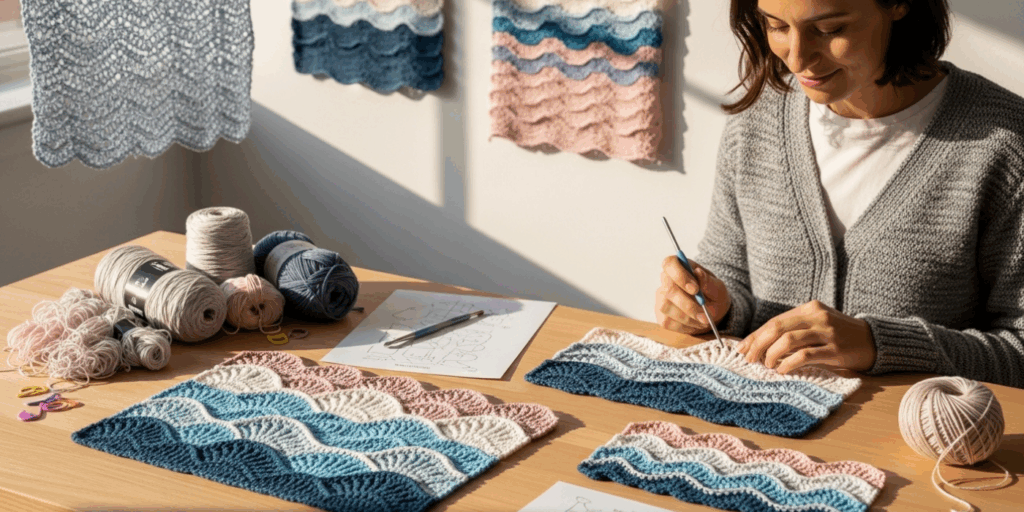
If the popcorn stitch is playful, the shell stitch is poetry in motion.
Shells are clusters of stitches—usually 5 to 7 double crochets—worked into a single stitch or space, then spaced out with gaps to form graceful, curved “shells” that look like ocean waves frozen in yarn.
Unlike popcorns, which stand proud and upright, shells flow. They curve. They breathe.
Why this stitch transforms your work: Shells add rhythm. They turn a plain scarf into a flowing river of texture. They turn a simple baby blanket into a dreamy seascape. The beauty lies in the negative space between shells—it’s not empty; it’s intentional. It lets your eye rest, then dance again.
A story to remember: I once met a woman at a craft fair who made shawls using shell stitch patterns inspired by her grandmother’s quilts. “She didn’t crochet,” the woman told me. “But she taught me that beauty isn’t in filling every space—it’s in letting some breathe.”
How to make a classic shell:
- Skip 2 stitches.
- Work 5 double crochets into the next stitch.
- Skip 2 stitches.
- Single crochet in the next.
- Repeat across the row.
Try this: Use a gradient yarn. Watch how the color shift makes each shell glow like a sunset. Or pair it with a lace edge for a delicate, vintage feel.
Shell stitch isn’t just pretty—it’s emotional. It reminds us that rhythm, repetition, and space are forms of art. And in our fast-paced world? That’s a gift.
The Bullion Stitch: Luxury in Every Twist
Now, let’s talk about the stitch that makes seasoned crocheters gasp: the bullion stitch.
This isn’t for the faint of heart—or the impatient. The bullion stitch involves wrapping the yarn around your hook 5 to 10 times (yes, really!), then pulling it all through in one smooth motion. The result? A tight, twisted column of yarn that looks like a tiny, plump rope standing tall from your fabric.
It’s the haute couture of crochet.
Why it’s worth the effort: Bullion stitches create a tactile luxury. They shimmer under light. They feel dense and substantial—like velvet made of yarn. They’re the secret behind high-end amigurumi animals with plush fur, elegant shawls with 3D floral accents, and even statement earrings that look like spun gold.
I remember making my first bullion stitch. I fumbled. I unraveled. I almost gave up. Then—click—it happened. One perfect, bouncy little column rose from my work. I stared at it for five minutes. It felt like I’d unlocked a hidden language.
How to do it (simplified):
- Yarn over 6–8 times (more wraps = thicker bullion).
- Insert hook into next stitch.
- Catch the yarn with the hook and pull through all loops at once.
- Chain 1 to secure.
Pro tips:
- Use a thinner yarn (like sport or fingering weight) for finer detail.
- Work bullions into a foundation of single crochet for better stability.
- Practice on a swatch first. It’s okay if your first five look like lopsided caterpillars.
Real application: Bullion stitches are perfect for adding dimension to holiday ornaments, the edges of winter scarves, or even as “petals” on a crocheted flower bouquet. One artist I follow creates bullion-stitched floral crowns—each bloom is a tiny, wearable sculpture.
This stitch isn’t just advanced—it’s alchemical. You’re turning simple yarn into something that feels expensive, rare, and deeply personal.
The Waffle Stitch: Cozy Geometry in Every Square
If you’ve ever hugged a thick, squishy bath towel and thought, “I wish my blanket felt like this,” meet the waffle stitch.
Also called the “griddle stitch” or “honeycomb stitch,” the waffle stitch creates a grid of raised squares that look like the surface of a freshly baked waffle. It’s thick, bouncy, and unbelievably warm.
Why it’s a game-changer: This stitch isn’t just about texture—it’s about function. The raised squares trap air, making it one of the warmest crochet patterns for blankets, robes, and even pet beds. And because it’s so dense, it hides mistakes beautifully.
Think of it as the ultimate “hug in yarn form.”
How it works: The pattern alternates between front post and back post double crochets in a specific sequence. You’re literally “lifting” stitches forward and backward to create the 3D grid.
Step-by-step cheat sheet:
- Row 1: Chain an even number. Work 1 front post double crochet (fpdc), then 1 back post double crochet (bpdc), repeat.
- Row 2: Reverse it—bpdc, then fpdc.
- Repeat rows 1 and 2.
The magic? The texture isn’t just on the surface—it’s throughout. The fabric has depth. It’s reversible. And it feels like a warm hug every time you touch it.
One crocheter told me she made a waffle-stitch throw for her elderly mother, who has arthritis. “She doesn’t talk much anymore,” she said, “but she runs her hands over it every morning. She smiles. That’s all I need.”
Use bulky yarn for maximum coziness. Try a cream and oatmeal color combo for that “spa day” vibe. Pair it with a simple border, and you’ve got a heirloom-quality blanket that’ll last decades.
The Tunisian Crochet Family: The Bridge Between Knitting and Crochet
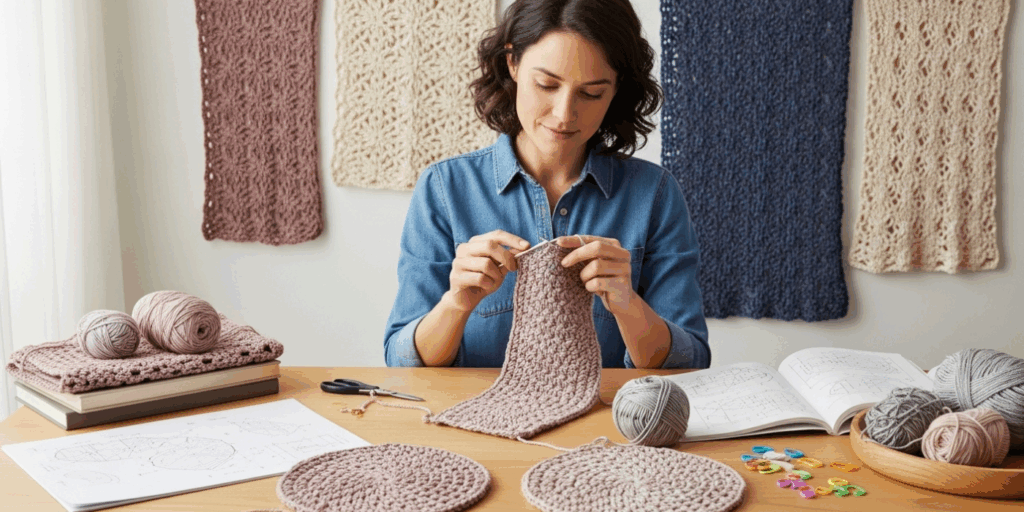
Now, let’s step into a world that feels almost forbidden to many crocheters: Tunisian crochet.
No, it’s not knitting. But it’s not traditional crochet either. It’s something in between.
Tunisian crochet uses a long hook (called a Tunisian hook or afghan hook) and works in two passes: a forward pass (picking up loops) and a return pass (working them off). The result? A dense, fabric-like texture that looks almost woven.
Why it’s revolutionary:
- It creates smooth, drapey fabrics perfect for sweaters and shawls.
- The stitches lie flat without curling.
- It’s ideal for intricate colorwork (like tapestry crochet) because the back side looks nearly as clean as the front.
I used to think Tunisian was “too complicated.” Then I made a simple Tunisian simple stitch scarf. Within two hours, I was hooked (pun intended). The fabric felt like a cross between a knit sweater and a handwoven tapestry. It was alive.
Try this beginner-friendly pattern:
- Chain 20.
- Forward pass: Insert hook under the front vertical bar of each chain, yarn over, pull up a loop (you’ll have 20 loops on your hook).
- Return pass: Yarn over, pull through 1 loop, then yarn over and pull through 2 loops until 1 remains.
- Repeat.
Pro tip: Use a smooth, medium-weight yarn. Avoid fuzzy yarns—they’ll hide the beautiful stitch definition.
Tunisian crochet opens doors to textures you can’t get with standard hooks: ribbed patterns, basketweave effects, even lace. It’s the secret weapon of designers who want the warmth of knitting with the versatility of crochet.
If you’ve ever felt limited by your tools, Tunisian crochet is your invitation to expand your universe.
Putting It All Together: Your Texture Toolkit
You don’t have to choose just one.
The real magic happens when you mix textures.
Imagine a blanket with:
- Popcorn stitches as stars in the corners,
- Shells framing the edges like ocean tides,
- Waffle stitch as the cozy center,
- And bullion stitches as delicate vines winding through.
That’s not just a blanket. That’s a narrative.
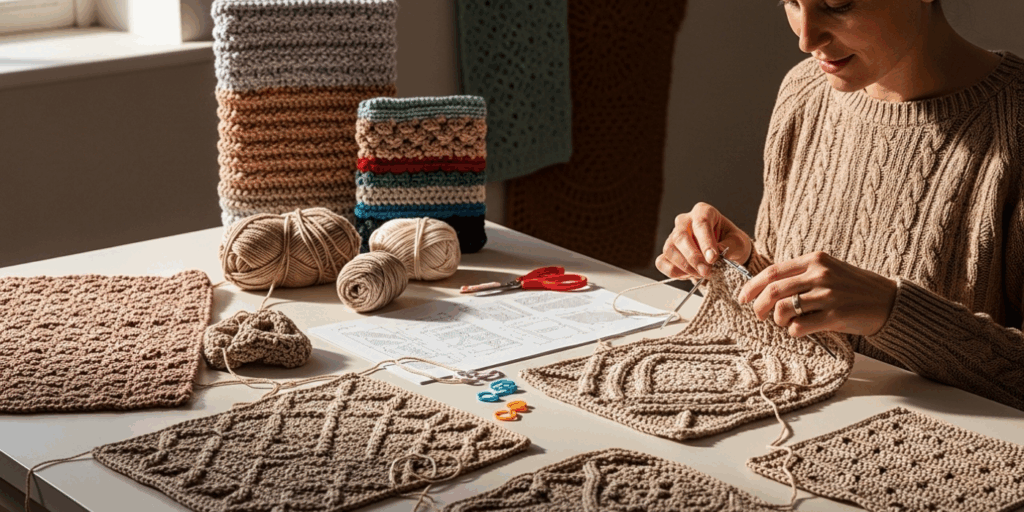
Start small: add one advanced stitch to a dishcloth. Try a Tunisian border on a simple scarf. Use a single bullion stitch as a button accent on a cardigan.
Texture isn’t about complexity—it’s about intention.
Every stitch you learn adds a new word to your creative vocabulary. And when you combine them? You’re not just making things. You’re telling stories.
Conclusion: Your Hands Are the Brush, Your Yarn Is the Paint
Let’s be honest: we live in a world that rewards speed. Fast fashion. Instant meals. Scroll-and-forget content.
But crochet—real crochet—demands presence.
The popcorn stitch asks you to pause and pop.
The shell stitch invites you to breathe between each curve.
The bullion stitch requires patience, focus, and a little courage.
The waffle stitch rewards consistency.
The Tunisian hook? It teaches you to work differently—not faster, but deeper.
These aren’t just stitches. They’re invitations—to slow down, to create with heart, to make something that matters.
The next time you pick up your hook, don’t just think, “What should I make?” Ask yourself: What feeling do I want this piece to hold?
Warmth? Joy? Comfort? Quiet strength?
Then choose your stitches like colors on a palette.
You don’t need to master them all at once. Just try one.
Make a swatch. Touch it. Let it surprise you.
Because the most beautiful things in life aren’t found in patterns—they’re found in the quiet moments between your fingers and the yarn.
So go on. Try a bullion stitch today.
Let your next project be more than pretty—let it be unforgettable.
And when you do… I’d love to hear about it.
What texture will you create first? Share your journey in the comments—I’m cheering you on.

Luiza Santos is a passionate crochet and knitting enthusiast who finds joy in transforming simple yarn into meaningful, handmade creations. With a deep love for texture, color, and craftsmanship, she believes every stitch carries a story. Luiza brings warmth, creativity, and years of hands-on experience to everything she makes, inspiring others to discover the beauty of fiber arts.