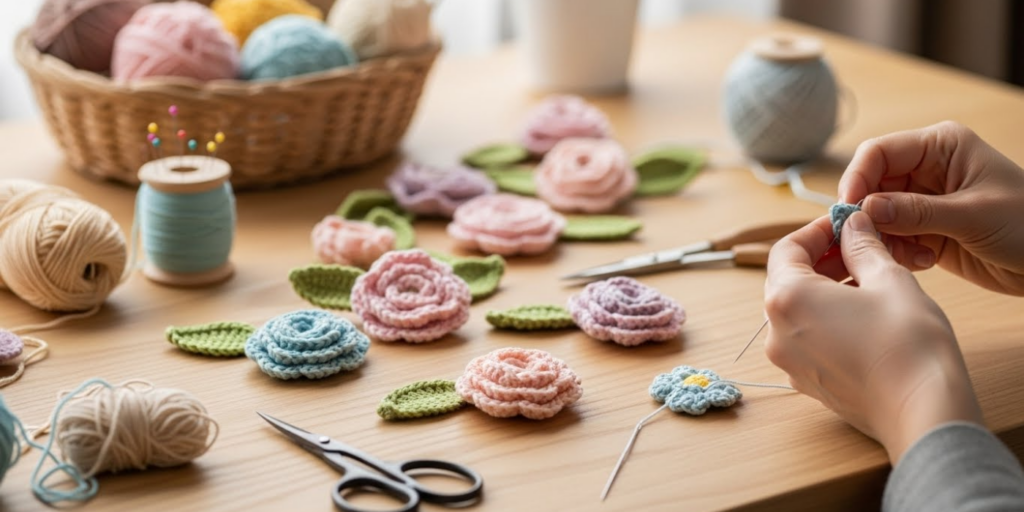
Imagine turning a simple headband into a garden crown, transforming a plain tote bag into a blooming masterpiece, or giving a baby blanket that extra touch of handmade love—all with the magic of 3D crochet flowers. These dimensional blossoms aren’t just pretty; they’re powerful little accents that breathe life, texture, and personality into any project.
Whether you’re a beginner looking to practice basic stitches in a fun way or an experienced crocheter seeking to elevate your designs, 3D floral embellishments are surprisingly accessible, endlessly customizable, and perfect for using up leftover yarn.
In this guide, we’ll explore why 3D crochet flowers are worth your time, walk through the essential techniques and stitches you’ll use most, share step-by-step tips for creating your first bloom, and offer dozens of creative ways to use them—from fashion and home décor to gifts and seasonal crafts. By the end, you’ll be inspired to grab your hook, pick a colorful skein, and start stitching your own floral garden, one petal at a time.
Let’s make your crochet bloom!
Why 3D Crochet Flowers Are More Than Just Cute
At first glance, 3D crochet flowers might seem like purely decorative—adorable, yes, but maybe “just for show.” But they’re actually incredibly practical and versatile.
For beginners, they’re a fantastic way to practice key techniques—like working in the round, increasing evenly, and switching colors—without the pressure of a large project. For seasoned crafters, they’re a creative outlet to experiment with texture, shape, and color theory.
Plus, they solve real crafting problems:
- Got a small mistake on a scarf? Cover it with a flower!
- Made a beanie that’s a little too plain? Add a rose to the brim.
- Need a last-minute gift? Stitch a bouquet of tiny blossoms onto a hair clip or keychain.
Moreover, 3D flowers are eco-friendly stash-busters. You can make dozens from leftover scraps of worsted, cotton, or even sock yarn. And because they’re handmade, each one is unique—a far cry from mass-produced plastic embellishments.
Fun fact: During the Victorian era, “talking bouquets” (called tussie-mussies) carried secret messages through flower choices. Today, your crocheted posy can say “I love you,” “Get well soon,” or “You’re blooming beautifully”—all without a single word.
Basic Stitches and Techniques You’ll Use
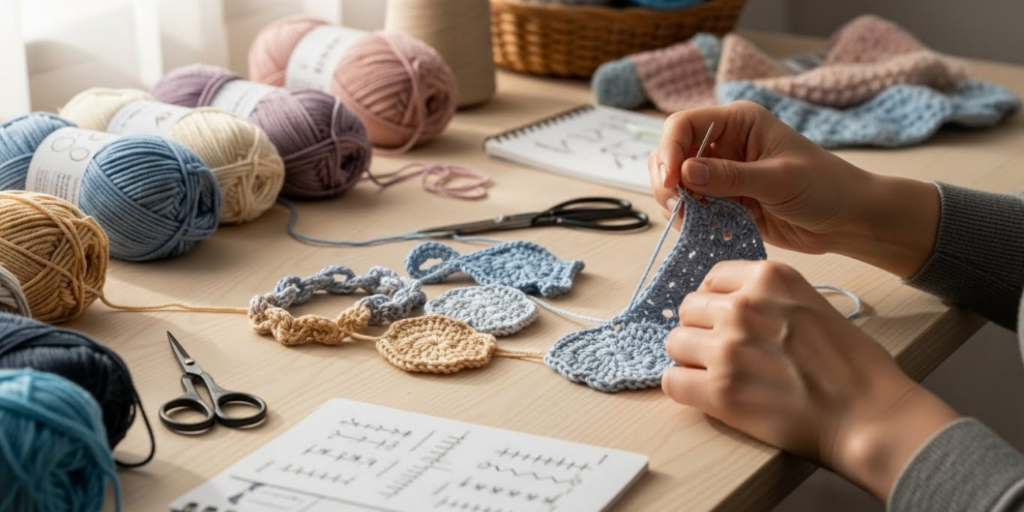
The beauty of 3D crochet flowers is that you don’t need advanced skills. Most designs rely on just a handful of foundational stitches—many of which you likely already know. Here’s what you’ll use most:
1. Chain Stitch (ch)
The backbone of most flower patterns. You’ll use chains to create petals, centers, and stems.
2. Single Crochet (sc) and Slip Stitch (sl st)
Perfect for tight, dense centers or joining rounds cleanly. Slip stitches are especially useful for moving your yarn without adding height.
3. Double Crochet (dc) and Treble Crochet (tr)
These taller stitches create volume and curve—ideal for lifelike petals that fan outward. Cluster stitches (like dc3tog) help shape rounded petal tips.
4. Working in the Round
Almost all 3D flowers are crocheted in spirals or joined rounds. Learning to increase evenly (e.g., 2 sc in each stitch around) is key to flat, circular bases.
5. Shaping with Increases and Decreases
To make petals look natural, you’ll often increase in the middle of a row (for width) and decrease at the edges (for tapering). Simple decreases like sc2tog keep edges smooth.
Pro tip: Use a stitch marker to mark the beginning of each round. It’s easy to lose count when working small circles!
Don’t worry if you’re new to these—most flower patterns come with full written instructions and even video tutorials. Start with a 5-petal basic flower, and you’ll master the rhythm quickly.
Step-by-Step: Making Your First 3D Crochet Flower
Ready to try? Here’s a simple method to create a classic 6-petal bloom (great for beginners):
Materials Needed:
- Worsted-weight yarn (cotton or acrylic works well) in two colors (one for petals, one for center)
- Size H/5.0mm crochet hook
- Yarn needle
- Scissors
Instructions:
1. Make the center:
- With Color A, ch 4, sl st to form a ring.
- Round 1: 6 sc into ring, sl st to first sc. (6 sts)
- Fasten off, leaving a long tail for sewing.
2. Create the petals (Color B):
- Join Color B with a sl st to any stitch on the center.
- Ch 3 (counts as first dc), 2 dc in same stitch → this is your first petal base.
- Ch 2 (this arch will separate petals).
- 3 dc in next stitch, ch 2.
- Repeat around (6 petals total).
- Join with a sl st to the top of the first ch-3.
3. Finish and attach:
- Weave in ends. Gently pull the center tail to slightly gather the middle if desired.
- Use the long tail to sew your flower onto a project!
Customize it: Try 8 petals for a fuller look, or use variegated yarn for ombré effects. Switch to lace-weight yarn and a small hook for delicate baby bouquet flowers.
The key? Don’t aim for perfection. Slight asymmetry makes your flowers look more organic and charming.
Creative Ways to Use 3D Crochet Flowers
Once you’ve made a few, you’ll start seeing endless possibilities. Here are some of our favorites:
1. Fashion & Accessories
- Headbands & hair clips: Perfect for kids’ recitals or boho-chic outfits.
- Sweater accents: Sew a cluster of roses along a neckline or cuff.
- Bag embellishments: Turn a plain canvas tote into a garden tote with daisies and leaves.
2. Home Décor
- Pillow appliqués: Mix large and small flowers for a textured throw pillow.
- Wall art: Mount flowers on a painted canvas or embroidery hoop for 3D wall decor.
- Curtain ties or lampshade trim: Add soft, romantic details to your space.
3. Gifts with Heart
- Baby blankets: Stitch tiny flowers into the border (use soft cotton and secure all ends well).
- Greeting cards: Glue a miniature flower to the front of a handmade card.
- Wedding favors: Create floral brooches or bouquet charms for bridesmaids.
4. Seasonal & Holiday Crafts
- Easter eggs: Crochet tiny flowers to nestle around decorated eggs.
- Christmas ornaments: Make poinsettias or holly berries for your tree.
- Spring wreaths: Attach a floral garland to a foam or wire base.
Sustainability bonus: Instead of buying plastic silk flowers, your crocheted versions are reusable, washable, and plastic-free.
Remember: Less is often more. A single bold bloom can be more impactful than a cluttered cluster. Think about balance, color harmony, and the story you want your project to tell.
Tips for Realistic and Long-Lasting Flowers
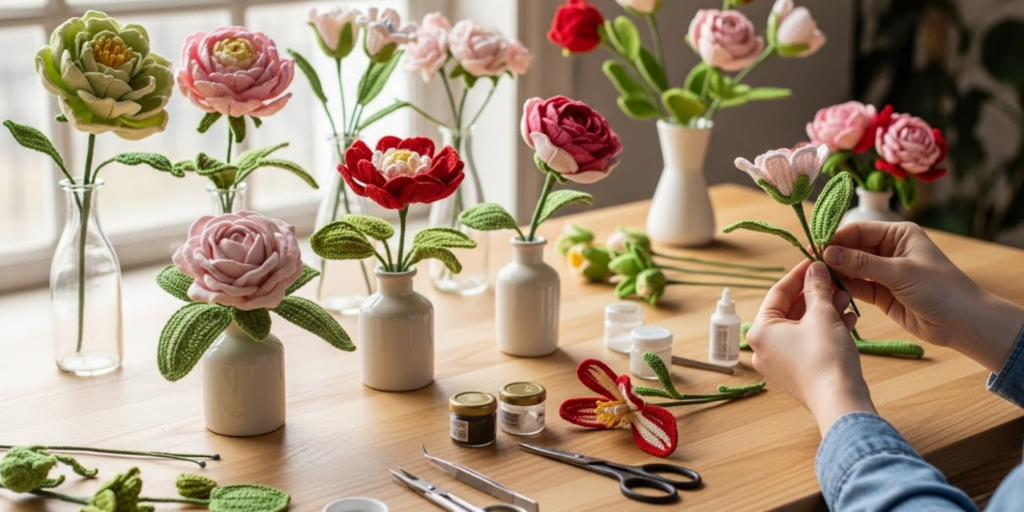
Want your flowers to look natural and hold their shape? Try these pro techniques:
1. Block your flowers
Lightly spritz finished flowers with water, pin them into shape on a towel, and let dry. This evens out stitches and opens up petals beautifully—especially with cotton or wool.
2. Add dimension with stuffing
For extra-plump centers (like in peonies or dahlias), add a tiny pinch of polyester fiberfill before closing the final round.
3. Mix yarn weights and textures
- Use matte cotton for realistic daisies.
- Try shiny mercerized cotton for dewy lilies.
- Blend in chenille or velvet yarn for velvety rose petals (sparingly—these can be tricky to stitch!).
4. Include leaves and stems
A flower rarely stands alone! Crochet simple leaf shapes (often just chain + sc rows) and attach them beneath your bloom for realism. Use green embroidery floss to stitch veins.
5. Secure your attachments well
If your flower will be handled often (like on a child’s hat), sew through multiple layers and knot your thread several times. You can even add a small button on the back for reinforcement.
Note: Always consider washing instructions. If the base item is machine-washable, use a durable yarn like acrylic or superwash cotton for your flowers.
Inspiration from Nature and Tradition
Nature is your best teacher. Take a walk and observe real flowers:
- How many petals does a buttercup have? (Usually 5)
- Are the edges smooth or ruffled? (Poppies are ruffled; daisies are smooth)
- How do the petals layer? (Roses spiral; sunflowers radiate outward)
You can also explore traditional motifs:
- Mexican flor de cempasúchil (marigold): bright orange, ruffled, used in Día de Muertos
- Ukrainian vinok (flower crown): symbolic blooms like periwinkle and sunflowers
- Victorian floriography: red roses for love, violets for modesty, forget-me-nots for remembrance
These cultural touches add meaning and depth to your creations—making them more than just decoration, but storytelling tools.
Conclusion: Let Your Creativity Bloom
3D crochet flowers are far more than pretty add-ons—they’re gateways to creativity, confidence, and connection. They let you transform ordinary projects into extraordinary expressions of care, whether you’re covering a stain, celebrating a loved one, or simply playing with color and form.
In this guide, we’ve covered:
- Why these embellishments are practical and meaningful
- The basic stitches and techniques you need
- A simple step-by-step flower pattern to get you started
- Dozens of creative uses across fashion, home, and gifts
- Pro tips for realism, durability, and inspiration
Now, it’s your turn. Grab that scrap of yarn in your stash—the one that’s been calling your name—and stitch your first petal. Don’t worry about making it perfect. Make it joyful. Make it yours.
And when you’re done, we’d love to see it! Share a photo in the comments or tag us on social media. What kind of flower will you make first—a sunny daisy, a romantic rose, or a fantasy blossom from your imagination?
After all, every great garden starts with a single seed… or in this case, a single stitch. 🌸

Luiza Santos is a passionate crochet and knitting enthusiast who finds joy in transforming simple yarn into meaningful, handmade creations. With a deep love for texture, color, and craftsmanship, she believes every stitch carries a story. Luiza brings warmth, creativity, and years of hands-on experience to everything she makes, inspiring others to discover the beauty of fiber arts.