What if you could crochet without counting stitches, following rows, or worrying about gauge? What if your hook became a paintbrush, your yarn a palette of color and texture, and your project a spontaneous work of wearable art? Welcome to freeform crochet—a liberating, intuitive, and wildly creative approach that throws the rulebook out the window and invites you to stitch from the heart.
Unlike traditional crochet, which relies on precise patterns and uniform tension, freeform crochet celebrates imperfection, asymmetry, and personal expression. Think of it as the jazz improvisation of fiber arts: there are notes (stitches), but you’re free to riff, repeat, or abandon them as inspiration strikes.
In recent years, freeform has surged in popularity—not just among fiber artists, but among beginners seeking stress-free creativity and seasoned crocheters craving artistic freedom. Whether you’re making a sculptural wall hanging, a boho vest, or a one-of-a-kind amigurumi monster, freeform lets you create without limits.
In this guide, we’ll explore what freeform crochet really is, why it’s more accessible than you think, how to get started with zero experience, and inspiring ways to use it in real projects. By the end, you might just find yourself cutting loose—and loving every stitch.
What Is Freeform Crochet? (And Why It’s Not “Just Messy”)
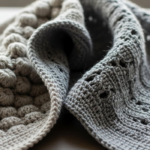
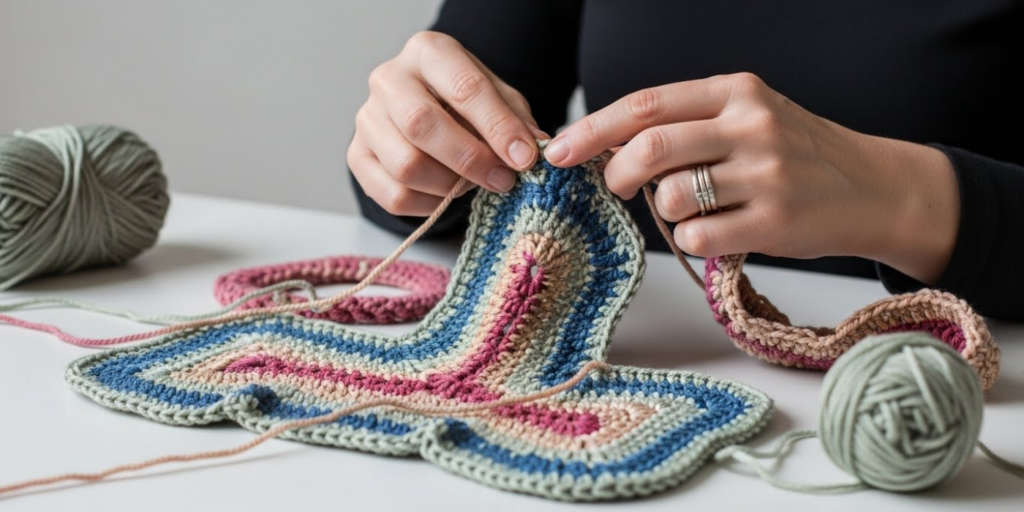
Freeform crochet—also called scrumbling, freestyle crochet, or organic crochet—is a non-linear method where you build fabric by connecting stitches, motifs, and textures intuitively, rather than following a grid-like pattern.
Pioneered by Australian fiber artist Myra Wood and popularized by the late Sylvia Cosh, freeform embraces “controlled chaos.” You might start with a circle, add a spiral, attach a tendril of chains, then stitch on a cluster of popcorns—all in the same piece. There’s no “right side,” no “row 12,” and no fear of mistakes—because in freeform, “mistakes” often become the most interesting features.
Why it matters: In a world of fast fashion and mass-produced goods, freeform crochet is a rebellion of slowness and individuality. Each piece is inherently unique—impossible to replicate exactly, even by its maker. That’s not a flaw; it’s the point.
Why Try Freeform? The Creative (and Therapeutic) Benefits
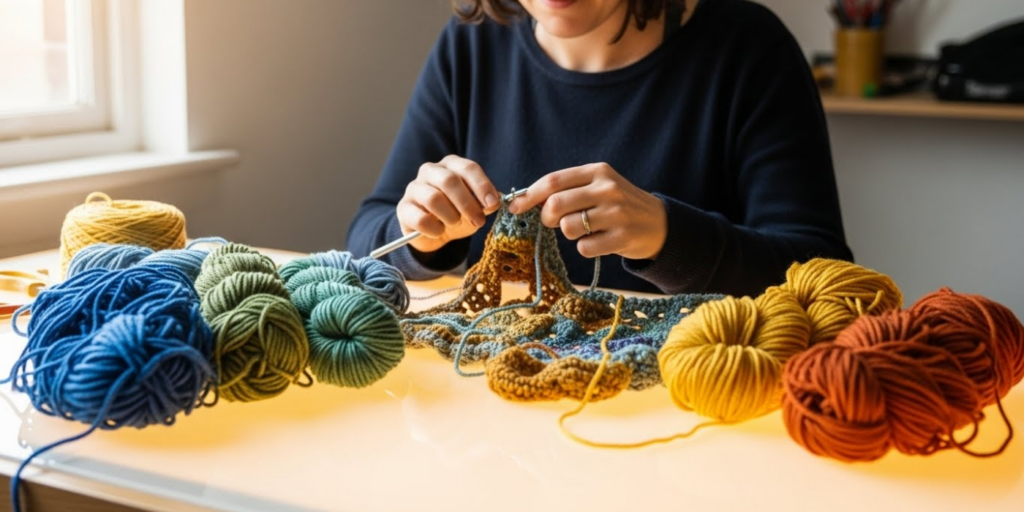
Beyond aesthetics, freeform offers real emotional and mental rewards:
- No pressure to be perfect: Forget tension swatches and stitch counts. Freeform thrives on irregularity.
- Mindful creativity: Without rigid instructions, you’re fully present in the moment—yarn in hand, hook in motion.
- Zero waste: Use up every scrap of leftover yarn. Freeform loves color and texture variety!
- Accessible to all skill levels: You only need to know a few basic stitches—chain, single crochet, slip stitch. That’s it.
- Highly expressive: Want to reflect a stormy mood? Use dark, twisted strands. Feeling joyful? Go wild with neon and fringe!
Many craft therapists now recommend freeform as a form of art-based mindfulness, especially for people dealing with anxiety or creative burnout. It’s play, not production.
Getting Started: Your First Freeform Project (Yes, Really!)
You don’t need a pattern—but you do need a mindset shift. Here’s how to begin:
Step 1: Gather Your “Junk Drawer” Yarn
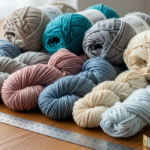
Collect scraps, odd balls, and leftover skeins—different weights, fibers, and colors. Wool, cotton, metallic, variegated—it all works. The more variety, the more dynamic your piece.
Step 2: Choose a Simple Base (Optional)
Some freeform artists start from scratch; others use a foundation like:
- A crocheted circle or square
- A mesh netting base (like tulle or plastic canvas)
- A pre-made garment (to embellish)
For your first try, make a freeform swatch: chain 10, join to form a ring, and work single crochets, chains, and clusters outward in any direction.
Step 3: Stitch Without Rules
Ask yourself:
- What stitch feels right now?
- Should I add length, texture, or color here?
- Does this need a bump, a hole, or a curl?
Use basic stitches, but modify them:
- Make chains longer or shorter
- Skip loops or add extra ones
- Work stitches into the front, back, or sides of previous rows
Pro tip: Keep a small notebook nearby to jot down ideas or techniques you discover. Freeform is full of happy accidents—you’ll want to remember them!
Essential Techniques to Fuel Your Freeform Journey
While there are no rules, a few go-to methods help build dimension and cohesion:
- Attaching new yarn: Instead of weaving in ends, simply knot or loop new yarn to old. Let tails dangle as fringe!
- Joining motifs: Use slip stitches, chains, or “bridge stitches” to connect separate crocheted elements.
- Adding texture: Mix in popcorn stitches, bobbles, crocodile stitch segments, or even Tunisian crochet patches.
- Working in 3D: Don’t stay flat! Curl edges, puff out centers, or stitch upward to create sculptural forms.
- Using unconventional materials: Try ribbon, fabric strips, leather cords, or recycled sari silk for surprise elements.
Remember: Tension doesn’t matter. A loose stitch next to a tight one? That’s contrast—not a mistake.
From Swatch to Statement: Real Projects You Can Make
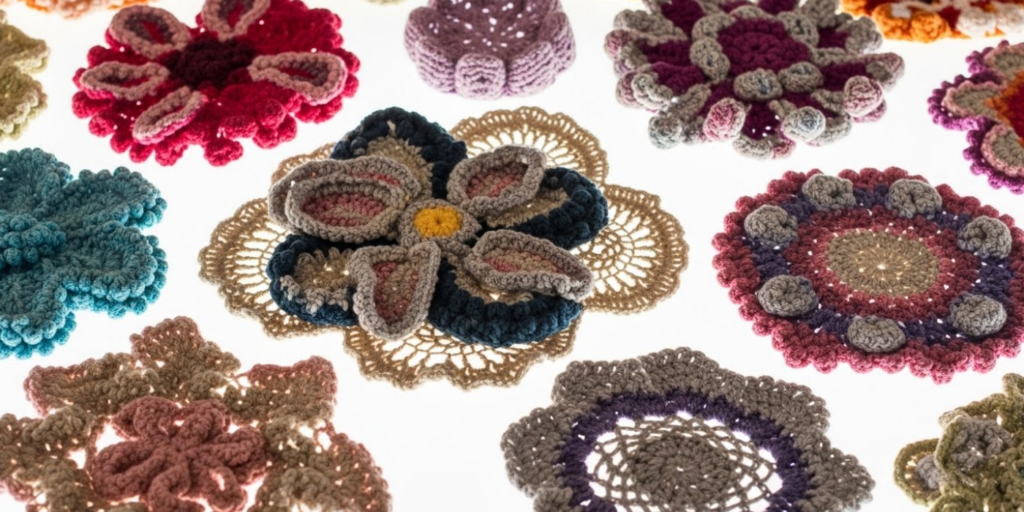
Freeform isn’t just abstract art—it’s wearable, usable, and deeply personal. Try these ideas:
🧣 Freeform Scarves & Cowls
Start with a chain, then let the piece grow organically. Add ruffles, tassels, or lace panels as you go. No two ends need to match!
🧥 Boho Jackets & Vests
Begin with a simple rectangle or use a thrifted blazer as a base. Embellish sleeves, collars, and hems with freeform appliqués, floral bursts, or fringe gardens.
🖼️ Wall Art & Sculptures
Mount your freeform piece on a canvas or stretch it over a frame. Some artists create entire landscapes—forests, oceans, galaxies—using only yarn and hook.
🪆 Amigurumi Reimagined
Why make a standard teddy bear when you can create a creature with three eyes, rainbow tentacles, and button wings? Freeform amigurumi has no anatomy rules.
🧵 Mixed-Media Collage
Combine crochet with embroidery, beads, buttons, or even paint. One artist crocheted directly onto vintage book pages to create poetic textile journals.
The only limit? Your imagination.
Overcoming the “But Is It Real Crochet?” Doubt
Many new freeform artists hear (or think): “This isn’t ‘proper’ crochet.” But here’s the truth: crochet has always been evolving.
In the 1800s, Irish crochet lace was considered radical. In the 1970s, granny squares were dismissed as “old-fashioned”—until they became icons of counterculture fashion. Artistic crochet—from the avant-garde work of Nick Cave’s Soundsuits to the installations of Erin M. Riley—proves that fiber art belongs in galleries, not just living rooms.
Freeform isn’t “less than”—it’s a different branch of the same creative tree. And it’s deeply rooted in folk traditions worldwide, from Andean textiles to African mud cloth, where irregularity signifies humanity, not error.
So if someone questions your freeform piece, smile and say: “It’s not broken—it’s breathing.”
Tips from the Pros: Wisdom from Freeform Artists
We spoke with fiber artists who live and breathe freeform. Their top advice:
- “Start ugly”: Give yourself permission to make “bad” freeform. The magic happens in layering.
- “Work small first”: A 4×4″ swatch feels less daunting than a full vest.
- “Use a journal”: Sketch shapes, color combos, or emotions before you stitch.
- “Don’t over-plan”: Let the yarn lead. Sometimes the best ideas emerge mid-stitch.
- “Embrace the ‘oops’”: A dropped stitch? Turn it into an eye. A tangled yarn? Braid it into the design.
As artist Kaffe Fassett once said: “The eye doesn’t tire of variety—it craves it.”
Freeform as a Practice of Self-Trust
More than a craft, freeform crochet is a metaphor for life. It teaches us to:
- Trust our instincts over instructions
- Find beauty in asymmetry
- Turn “flaws” into features
- Create without needing permission
In a world that demands productivity and perfection, stitching without a map is a quiet act of rebellion. Every loop becomes a whisper: You are enough. Your voice matters. Your chaos has rhythm.
Conclusion: Dare to Stitch Without a Safety Net
Freeform crochet isn’t about making something “pretty” by conventional standards. It’s about making something true—to your mood, your materials, your moment. It’s slow, soulful, and deeply human.
You don’t need expensive tools, rare yarns, or advanced skills. You just need a hook, some leftover string, and the courage to begin without knowing where you’ll end up.
So tonight, instead of reaching for another pattern, reach for that bag of yarn scraps. Make a single chain. Then another. Then let your hand wander. You might just stitch your way to something wildly, imperfectly, beautifully yours.
Now we’d love to hear from you: Have you ever tried freeform crochet? What held you back—or what surprised you most? Share your thoughts, questions, or photos in the comments below. Your journey might inspire someone else to cut loose and create! 🧶✨
Luiza Santos is a passionate crochet and knitting enthusiast who finds joy in transforming simple yarn into meaningful, handmade creations. With a deep love for texture, color, and craftsmanship, she believes every stitch carries a story. Luiza brings warmth, creativity, and years of hands-on experience to everything she makes, inspiring others to discover the beauty of fiber arts.