You’ve spent hours perfecting your stitch count, testing your gauge, and photographing your finished piece in golden-hour light. But when you upload your pattern to Etsy, Ravelry, or your website, it gets lost in a sea of thousands. Why? Often, it’s not the pattern that’s the problem—it’s the description.
In today’s crowded handmade market, your pattern description is your silent salesperson. It’s the first thing a potential buyer reads—and it has just 7 seconds to convince them your design is worth their time, money, and yarn stash.
The good news? Writing a compelling description isn’t about fancy words or marketing fluff. It’s about clarity, connection, and confidence. In this guide, you’ll learn exactly how to write crochet pattern descriptions that sell—even if you’ve never written copy before.
We’ll break down the key elements of high-converting listings, share real-life examples, and give you practical templates you can use today. Whether you’re selling your first pattern or building a full-time business, these strategies will help your work get the attention it deserves.
Let’s turn your beautiful stitches into irresistible stories.
1. Why Your Pattern Description Matters More Than You Think
It’s easy to assume that a great photo and clear instructions are enough. But think about your own buying habits:
Have you ever scrolled past a stunning scarf because the description read, “Easy pattern. Uses worsted yarn.”?
Of course you have.
A weak description makes buyers hesitate, doubt, or click away. A strong one builds trust, answers questions before they’re asked, and helps the maker see themselves finishing your project.
Here’s the truth: Buyers aren’t just purchasing a pattern—they’re buying:
- Confidence (“Can I really make this?”)
- Inspiration (“Will this look good on me/in my home?”)
- Time savings (“Is this clearly written so I won’t get stuck?”)
Your description is where you deliver all three.
💡 Fact: Listings with detailed, benefit-driven descriptions convert 3–5x better than those with minimal text (Etsy Seller Handbook, 2024).
2. The 5 Essential Elements of a High-Converting Description
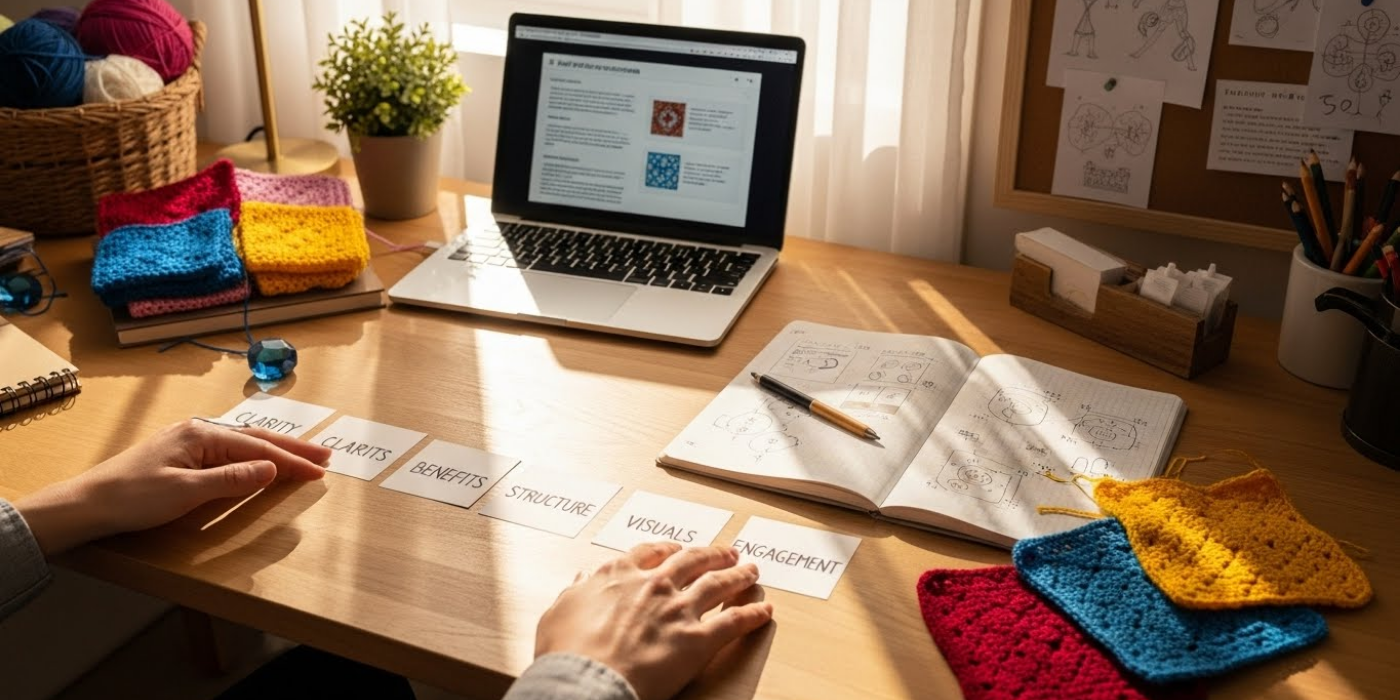
A winning pattern description isn’t a wall of text—it’s a strategic blend of key components. Include these five elements, and you’ll stand out instantly:
1. A Captivating Opening Hook
Start with an emotional or visual punch.
❌ “This is a beanie pattern.”
✅ “Wrap yourself in cloud-soft warmth with this slouchy beanie—perfect for crisp autumn mornings and weekend coffee runs.”
2. Clear Project Overview
Name the item, its purpose, and its vibe in one sentence.
“The ‘Coastal Breeze’ shawl is a lightweight, lace-trimmed wrap designed for breezy beach days and summer evenings.”
3. Skill Level & Key Features
Be specific:
- Skill level: “Advanced beginner” (not just “easy”)
- Stitches used: “Uses only single crochet, chain, and slip stitch”
- Construction method: “Worked flat in one piece—no sewing!”
This helps makers self-select and reduces support questions later.
4. Yarn & Hook Details
List:
- Yarn weight (e.g., “#4 Worsted”)
- Recommended brand + yardage (e.g., “3 skeins of Lion Brand Wool-Ease”)
- Hook size (with mm and US)
🌟 Pro Tip: Add “Yarn substitutions welcome!” to encourage creativity and reduce buyer hesitation.
5. What’s Included in the PDF
Set expectations:
- “Printable PDF with 8 pages of instructions”
- “Step-by-step photos for tricky sections”
- “Printer-friendly, ad-free layout”
This reassures buyers they’re getting a professional product.
3. Speak to Your Ideal Maker (Not Everyone)
Trying to appeal to “all crocheters” makes your description feel generic. Instead, write to one person.
Ask yourself:
- Who is this pattern really for?
- What do they care about?
- What are they afraid of?
Example:
If your pattern is a textured baby blanket, your ideal buyer might be:
“A new grandparent who wants to make a soft, heirloom-quality gift—but hasn’t crocheted in 20 years and worries about complicated stitches.”
Your description should say:
“Perfect for returning crafters! This blanket uses just two basic stitches (single and double crochet) and includes large-print instructions and close-up photos for every step.”
When you speak directly to one person, thousands feel seen.
4. Focus on Benefits—Not Just Features
This is the #1 mistake designers make.
Features tell. Benefits sell.
| Feature | Benefit |
|---|---|
| “Uses moss stitch” | “Creates a subtly textured fabric that hides imperfections—ideal for beginners!” |
| “Worked in the round” | “No seams to sew—finish faster and wear sooner!” |
| “Includes video tutorial” | “Never feel stuck! Watch me demonstrate tricky rows in real time.” |
Ask “So what?” after every feature.
“It’s a scarf… so what?” → “So you’ll have a go-to accessory that elevates every outfit—from yoga pants to office wear.”
This shift transforms your description from a spec sheet into a promise of transformation.
5. Use Social Proof and Storytelling
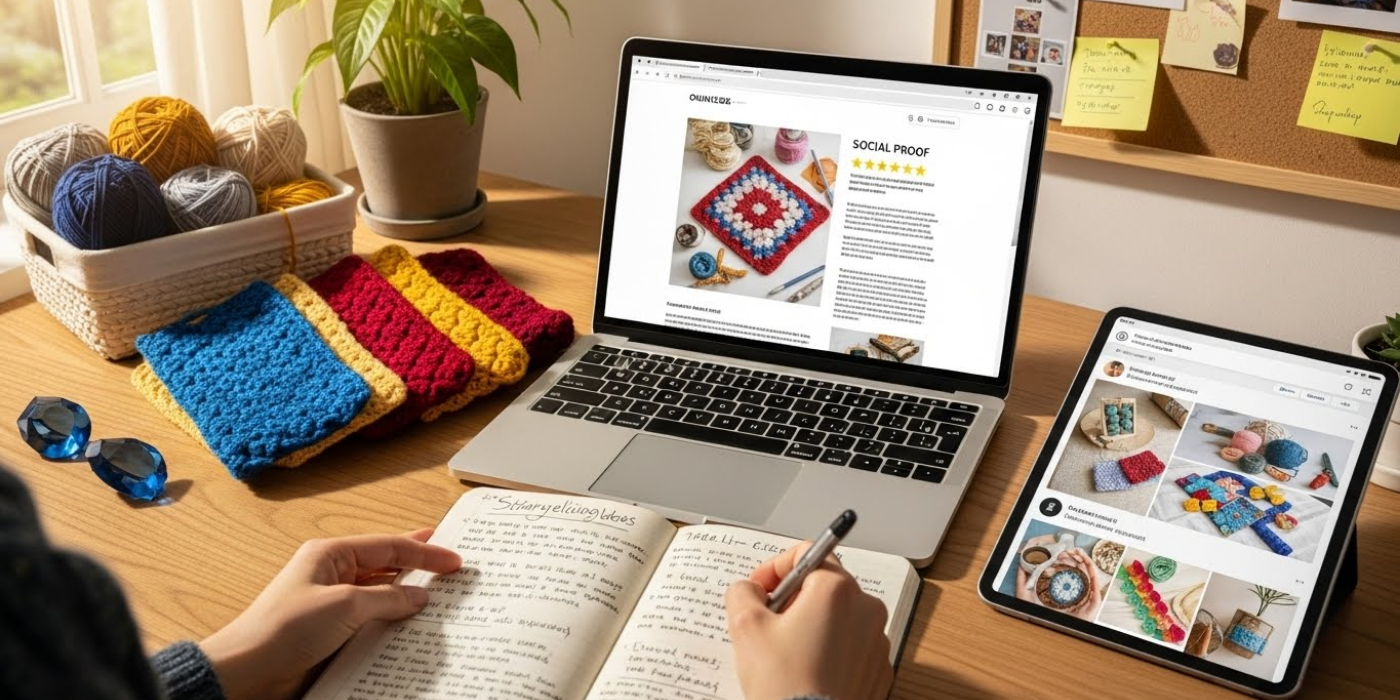
People trust other people—not sales pitches. Weave in authentic stories and social proof:
Share your “why”:
“I designed this market bag after one too many plastic bags ripped at the grocery store. Now I carry it everywhere—and get compliments every time!”
Include tester quotes:
“‘I’ve never made a bag before, but the photo tutorial made it easy!’ — Sarah, verified buyer”
Mention real-world use:
“Tested by 12 makers—from teens to grandmas—with consistent, flattering results.”
These elements build credibility and community, making your pattern feel tried, true, and trustworthy.
6. Optimize for Search (Without Sounding Robotic)
Yes, SEO matters—even on Etsy and Ravelry. But never sacrifice readability for keywords.
Do this:
- Naturally include phrases buyers search for:
- “Beginner-friendly crochet scarf pattern”
- “Quick baby blanket crochet pattern”
- “Free-standing lace doily pattern”
Don’t do this:
- “Crochet pattern crochet scarf pattern easy crochet scarf beginner scarf quick scarf…” (keyword stuffing!)
Best practice:
Use your main keyword in:
- The first sentence
- A subheading
- The closing paragraph
Google (and Etsy’s algorithm) rewards helpful, natural language—not robotic repetition.
7. Avoid These Common Description Mistakes
Even experienced designers slip up. Watch out for:
❌ Vague skill levels
“Easy” means different things to everyone. Use standardized terms:
- Beginner: basic stitches only
- Advanced Beginner: simple shaping, reading patterns
- Intermediate: colorwork, lace, garment construction
❌ Overpromising
Don’t say “fits all sizes” if your pattern only goes up to XL. Be honest—it builds long-term trust.
❌ Ignoring accessibility
- Use short paragraphs
- Bold key info (like yardage or hook size)
- Avoid ALL CAPS or excessive emojis
🧶 Remember: Many buyers read your description on their phone while standing in a yarn shop. Make it skimmable!
8. A Simple Template You Can Use Today
Stuck staring at a blank listing? Use this framework:
Hook: [One emotional or visual sentence]
What it is: [Name + purpose + vibe]
Perfect for: [Ideal maker + their need]
Why you’ll love it:
- Benefit 1 (e.g., “No sewing required!”)
- Benefit 2 (e.g., “Uses just 1 skein of yarn”)
- Benefit 3 (e.g., “Includes step-by-step photos”)
Details:- Skill level: [Be specific]
- Yarn: [Brand, weight, yardage]
- Hook: [Size in US + mm]
- Finished size: [Actual measurements]
Includes: [PDF features]
Story: [1–2 sentences about why you designed it]
This keeps your description focused, scannable, and sales-driven.
Conclusion: Your Words Are Part of Your Craft
Writing a great pattern description isn’t “extra work”—it’s an extension of your creativity. Just as you choose the perfect stitch for drape or the right yarn for softness, your words shape how your design is received.
When you write with clarity, empathy, and confidence, you do more than sell a pattern—you invite someone into your creative world. You give them permission to believe they can make something beautiful. And that’s a gift no algorithm can measure.
So next time you finish a pattern, don’t rush the description. Light a candle, pour some tea, and write like you’re telling your best crafting friend why they’ll adore this project.
Your stitches are beautiful. Now let your words be, too.
👉 We’d love to hear from you: What’s one tip you’ll try in your next listing? Or what pattern are you most proud of? Share in the comments below! And if this helped you, pin it or share it with a fellow designer—because when we lift each other up, the whole handmade community thrives.
Remember: Great patterns deserve great stories. Go write yours.

Luiza Santos is a passionate crochet and knitting enthusiast who finds joy in transforming simple yarn into meaningful, handmade creations. With a deep love for texture, color, and craftsmanship, she believes every stitch carries a story. Luiza brings warmth, creativity, and years of hands-on experience to everything she makes, inspiring others to discover the beauty of fiber arts.