You’ve just bought your first crochet hook, picked out a soft, colorful ball of yarn, and opened your first tutorial… only to realize you have no idea what “worsted weight” or “size H” even means.
Welcome to the wonderful, slightly confusing world of crochet basics.
If you’ve ever stared at a pattern and felt overwhelmed by terms like “DK,” “bulky,” or “3.5mm hook,” you’re not alone. Most new crocheters hit this wall early—and it’s not your fault. Yarn weights and hook sizes aren’t intuitive. They’re a language all their own, passed down through decades of crafters, with little explanation for beginners.
But here’s the good news: once you understand the relationship between yarn thickness and hook size, your projects will transform. Your stitches will look even. Your tension will feel natural. And most importantly—you’ll stop guessing and start creating with confidence.
In this guide, we’ll break down everything you need to know about yarn weights and hook sizes—no jargon, no fluff, just clear, practical advice designed for real beginners. By the end, you’ll be able to pick the right yarn and hook combo for any project, read patterns like a pro, and even troubleshoot common mistakes before they happen.
Let’s unravel this mystery—one stitch at a time.
Why Yarn Weight and Hook Size Matter More Than You Think
Imagine trying to paint a detailed portrait with a thick house-painting brush. Or using a fine-tip pen to fill in a large mural. The tools don’t match the task—and the result? Messy, frustrating, and far from what you envisioned.
That’s exactly what happens when your yarn and hook don’t work together.
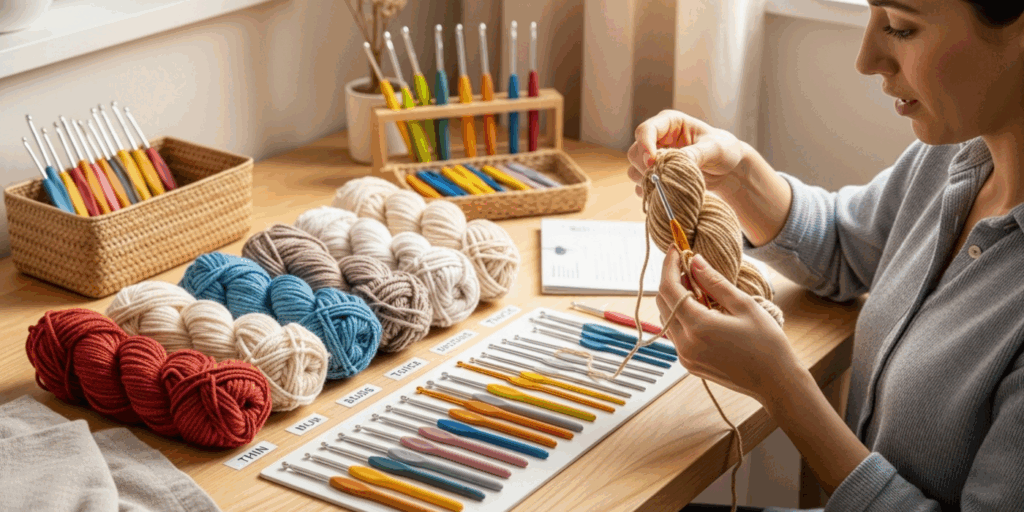
Yarn weight refers to the thickness of the yarn, not its actual weight in grams or ounces. It’s a standardized category that helps crocheters choose the right hook and get consistent results. Hook size, on the other hand, is the diameter of the hook’s shaft. Too small, and your stitches will be tight, stiff, and hard to work. Too large, and your fabric becomes loose, holey, and loses its shape.
Here’s the golden rule: Thicker yarn needs a larger hook. Thinner yarn needs a smaller hook.
But it’s not just about matching sizes—it’s about balance. The right combination creates fabric that’s soft, drapey, and sturdy enough to hold its form. A blanket made with bulky yarn and a tiny hook? It’ll be stiff and take forever. A delicate lace shawl with a huge hook? It’ll look more like a sieve than a shawl.
Think of it like baking. You wouldn’t use a cup of flour and a teaspoon of sugar and expect a cake. Crochet is the same. The ratio matters.
And here’s the kicker: most patterns assume you’re using the recommended yarn weight and hook size. If you swap them without adjusting, your finished item might be 20% too big—or too small. That’s the difference between a cozy hat and one that slides off your head.
Understanding this early saves you time, money, and heartache. You won’t waste hours unraveling a scarf that’s too loose. You won’t buy five skeins of yarn only to realize the pattern called for something completely different.
So let’s make this simple. Let’s learn the language.
The 7 Standard Yarn Weights (And What They’re Actually Used For)
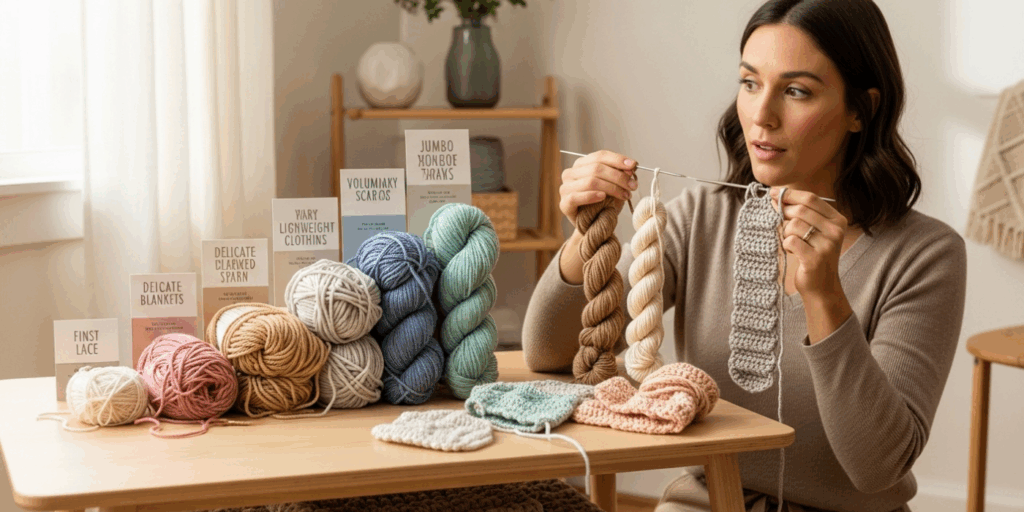
The Craft Yarn Council (the official standards body for yarn in the U.S.) has defined seven standard yarn weights—from the thinnest thread to the thickest roving. Think of them like T-shirt sizes: XS, S, M, L, XL, XXL, and XXL+.
Here’s your cheat sheet—with real-life examples so you know exactly what you’re working with:
- Lace (0) – So thin, it’s almost see-through. Perfect for delicate doilies, shawls, and lace trim. You’ll often see this labeled as “thread crochet.”
- Super Fine (1) – Also called fingering or sock yarn. Think baby socks, lightweight sweaters, or intricate lace patterns.
- Fine (2) – Known as sport or baby yarn. Great for lightweight garments, baby blankets, and summer tops.
- Light (3) – This is the DK (Double Knitting) weight. A favorite for sweaters, scarves, and hats. It’s versatile and beginner-friendly.
- Medium (4) – Worsted weight. The most popular yarn weight for beginners. Used in afghans, sweaters, amigurumi, and scarves. If a pattern doesn’t specify, this is probably what it means.
- Bulky (5) – Thick, cozy, and fast to work. Perfect for chunky blankets, cowls, and winter hats.
- Super Bulky (6) – The heavyweight champion. Think thick rugs, instant scarves, and oversized arm-knitted projects.
Pro tip: Look for the yarn label. You’ll see a number (0–6) and a symbol—a little ball with a number inside. That’s your official weight classification. Ignore the brand names (“baby yarn,” “aran”) and trust the number.
Now, here’s why this matters: Most beginner patterns use Medium (4) worsted weight. Why? Because it’s easy to see your stitches, doesn’t tangle as much as thinner yarn, and works well with medium-sized hooks. Starting here gives you room to grow.
If you’re unsure what to buy, grab a skein labeled “Medium” or “4” and move on to the next section.
How Hook Sizes Work (And Why the Numbers Don’t Always Make Sense)
Hook sizes can be confusing because there are two systems: U.S. letters/numbers and metric millimeters (mm).
A size “H” hook? That’s 5.0mm. A “G” is 4.0mm. A “J” is 6.0mm. But here’s the twist: not all brands label the same way. One company’s “H” might be slightly different than another’s. That’s why the metric system is your best friend.
Always look for the millimeter (mm) measurement. It’s universal. Whether you’re in Texas or Tokyo, a 5.0mm hook is a 5.0mm hook.
Here’s a simple matching guide for beginners:
| Lace (0) | 1.5 – 2.25 mm | B-1 to C-2 |
| Super Fine (1) | 2.25 – 3.5 mm | C-2 to E-4 |
| Fine (2) | 3.5 – 4.5 mm | E-4 to 7 |
| Light (3) | 4.5 – 5.5 mm | 7 to I-9 |
| Medium (4) | 5.0 – 6.0 mm | H-8 to J-10 |
| Bulky (5) | 6.5 – 9.0 mm | K-10.5 to M-13 |
| Super Bulky (6) | 9.0 – 15 mm+ | M-13 and up |
Important: This is a range. Patterns often suggest a specific size based on the stitch pattern. Always check the pattern first.
Let’s say a pattern says: “Use a 5.5mm hook with worsted weight yarn.” That’s your sweet spot. If you use a 4.0mm hook instead, your stitches will be tighter, your fabric denser, and your project smaller. If you use a 6.5mm hook? Your stitches will be looser, your fabric stretchier, and your project bigger.
This is why gauge matters. More on that soon.
BONUS TIP: If you’re just starting out, buy a hook set with sizes G (4.0mm), H (5.0mm), and I (5.5mm). These three cover 90% of beginner projects. Save the fancy hooks for later.
Matching Yarn and Hook Like a Pro: A Real-Life Example
Let’s say you want to make a cozy winter blanket.
You head to the store and see three options:
- A soft, fluffy super bulky yarn (weight 6)
- A classic worsted yarn (weight 4)
- A silky sport weight yarn (weight 2)
Which one should you pick?
Well, if you want something warm, quick, and perfect for snuggling on the couch? Super bulky wins. It’s thick, it’s cozy, and you’ll finish it in a weekend.
Now, what hook do you pair it with? Size K (6.5mm) or L (8.0mm). Why? Because a smaller hook would make it too tight—like trying to stuff a giant pillow into a tiny pillowcase. Too big? The stitches get sloppy, and the blanket loses structure.
But what if you wanted a lightweight summer blanket? Then you’d pick the sport weight yarn (weight 2) and a 4.0mm hook. It’ll be airy, breathable, and perfect for patio lounging.
Here’s the magic trick: Think about the end result.
- Cozy? → Thicker yarn + bigger hook
- Delicate? → Thinner yarn + smaller hook
- Fast project? → Thicker yarn
- Intricate design? → Thinner yarn
I remember my first project: a dishcloth. I used bulky yarn and a size H hook. It looked like a brick. I was so frustrated. Then I switched to worsted weight and a 5.0mm hook. Suddenly, my stitches looked even. My edges were straight. I finished it in an hour—and I was hooked (pun intended).
Your first project doesn’t have to be perfect. But it does have to feel good. And that starts with the right combo.
What Is Gauge? (And Why You Should Care—Even If You’re a Beginner)
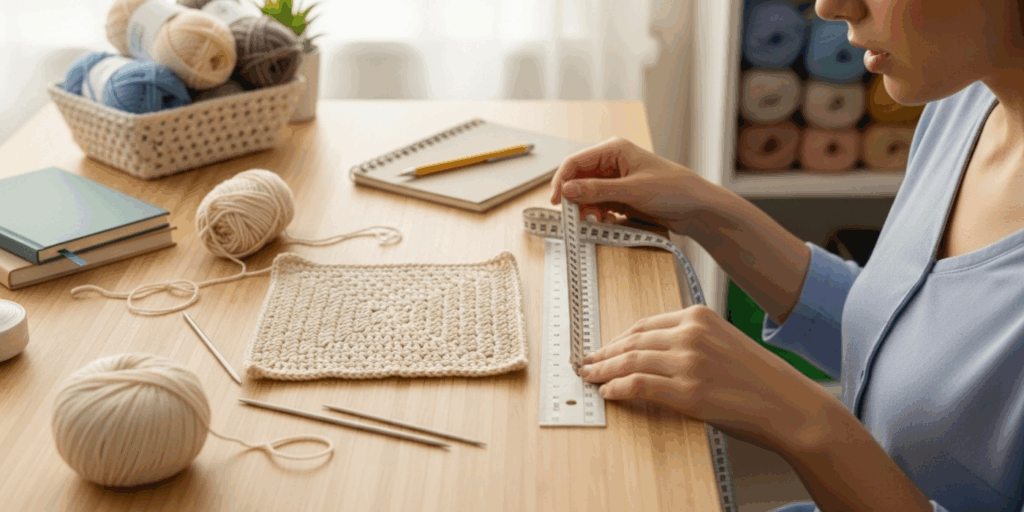
You’ve probably seen the word “gauge” in patterns. It sounds intimidating. “Gauge: 16 sts x 10 rows = 4 inches.” What does that even mean?
Simple: Gauge tells you how many stitches and rows fit into a 4-inch square using your chosen yarn and hook.
It’s like a recipe’s measuring cup. If you use too much flour, your cake collapses. If you use too few stitches, your sweater becomes a poncho.
Here’s why it matters for beginners: Even if you use the exact yarn and hook recommended, your tension might be different. Some people crochet tightly. Others crochet loosely. That’s normal!
So here’s what to do:
- Make a swatch. Chain 16 stitches. Work 10 rows in single crochet (or whatever stitch the pattern uses).
- Lay it flat. Don’t stretch it.
- Measure with a ruler. Does it measure exactly 4 inches wide and tall?
- Too small? Go up a hook size.
- Too big? Go down a hook size.
You might think, “I don’t have time for this!” But guess what? Spending 15 minutes on a swatch saves you 10 hours of unraveling a whole blanket later.
I once made a hat for my niece using the pattern’s recommended hook. I didn’t check gauge. When I tried it on her? It was the size of a large bowl. I had to rip it out. Twice.
Don’t be like me.
Gauge isn’t just for experts. It’s your secret weapon to avoid disappointment.
Common Mistakes (And How to Fix Them Before You Start)
Let’s talk about the top three mistakes new crocheters make—and how to dodge them.
Mistake #1: Using the wrong hook for the yarn.
You bought bulky yarn because it’s soft… but you’re using a 3.5mm hook. Your fingers hurt. Your stitches are cramped. Solution? Switch to a 7.0mm or 8.0mm hook. Let the yarn breathe.
Mistake #2: Ignoring the label.
That beautiful skein says “Recommended hook: 6.5mm.” You ignore it because “I’ve seen other patterns use H.” Maybe, but those patterns used different yarn. Always follow the yarn label’s suggestion first.
Mistake #3: Buying yarn without checking the dye lot.
If you’re using two skeins for a blanket, make sure they have the same dye lot number. Even the same color from different batches can vary slightly. You don’t want one half of your blanket to look like a different shade. Always buy enough yarn at once.
And here’s one more: Don’t buy yarn just because it’s pretty. Buy yarn because it’s right for your project. A sparkly novelty yarn might look amazing on the shelf—but it’s impossible to count stitches with. Save it for later.
Your First Project Checklist (Simple, Quick, and Satisfying)
Ready to put this all together?
Here’s your beginner-friendly checklist for your first successful project:
✅ Pick medium weight (4) yarn (worsted)
✅ Choose a 5.0mm or 5.5mm hook
✅ Use a simple stitch: single crochet or double crochet
✅ Make a 4×4 inch swatch to check tension
✅ If it’s too tight, go up a hook size. Too loose? Go down.
✅ Chain 20 stitches, work 10 rows
✅ Count your stitches—aim for 16–18 stitches across 4 inches
✅ Then make a dishcloth, coaster, or small scarf
✅ Celebrate! You did it.
You don’t need a blanket. You don’t need a sweater. Start small. Start simple. Start confident.
And if you make a mistake? That’s okay. Every crocheter has a “first ugly project.” Mine was a lopsided potholder shaped like a banana. I still keep it on my fridge.
Final Thoughts: Crochet Is About Joy, Not Perfection
You don’t need to memorize every yarn weight or hook size to be a great crocheter.
What you do need is curiosity. Patience. And the willingness to try.
Every expert crocheter started right where you are—staring at a ball of yarn, wondering what “DK” meant. They learned by doing. By messing up. By trying again.
The beauty of crochet is that it’s forgiving. One stitch doesn’t ruin the whole thing. You can always unravel and start over. And each time, you’ll understand a little more.
So go ahead. Pick up that worsted weight yarn. Grab your H hook. Make a chain. Work a few stitches. Feel the rhythm. Notice how the yarn glides. See how your hands learn.
This isn’t just about making blankets or scarves.
It’s about creating something with your own hands. Something warm. Something yours.
And that? That’s worth every moment.
What’s your first crochet project going to be?
Have you ever had a project turn out way too big—or too small? Share your story in the comments below! I read every one. And if you found this helpful, share it with a friend who’s just starting out. Let’s grow this community—one stitch, one hook, one beautiful creation at a time.
Happy crocheting. You’ve got this. 🧶💛
Luiza Santos is a passionate crochet and knitting enthusiast who finds joy in transforming simple yarn into meaningful, handmade creations. With a deep love for texture, color, and craftsmanship, she believes every stitch carries a story. Luiza brings warmth, creativity, and years of hands-on experience to everything she makes, inspiring others to discover the beauty of fiber arts.